Verified Excel workbook
Free 2026 Construction Contingency Workbook in Excel
Track construction contingency cost and allocation lines in a free Excel workbook with USD totals, open-item aging, exceptions, and project reviews.
Download the free Construction Contingency Tracker Workbook in Excel to keep user-entered contingency cost and allocation lines in one internal project-controls register. It supports practical review of projects, cost codes or allocation targets, transaction dates, owners, approval statuses, and source references. The workbook is intended to organize entered records, not replace the documents behind them.
Use the Cost Ledger to maintain the working record, then review calculated amounts, open-item aging, exceptions, and dashboard totals. Amounts are shown in USD, dates use m/d/yyyy formatting, and units of measure remain as entered without unit conversion.
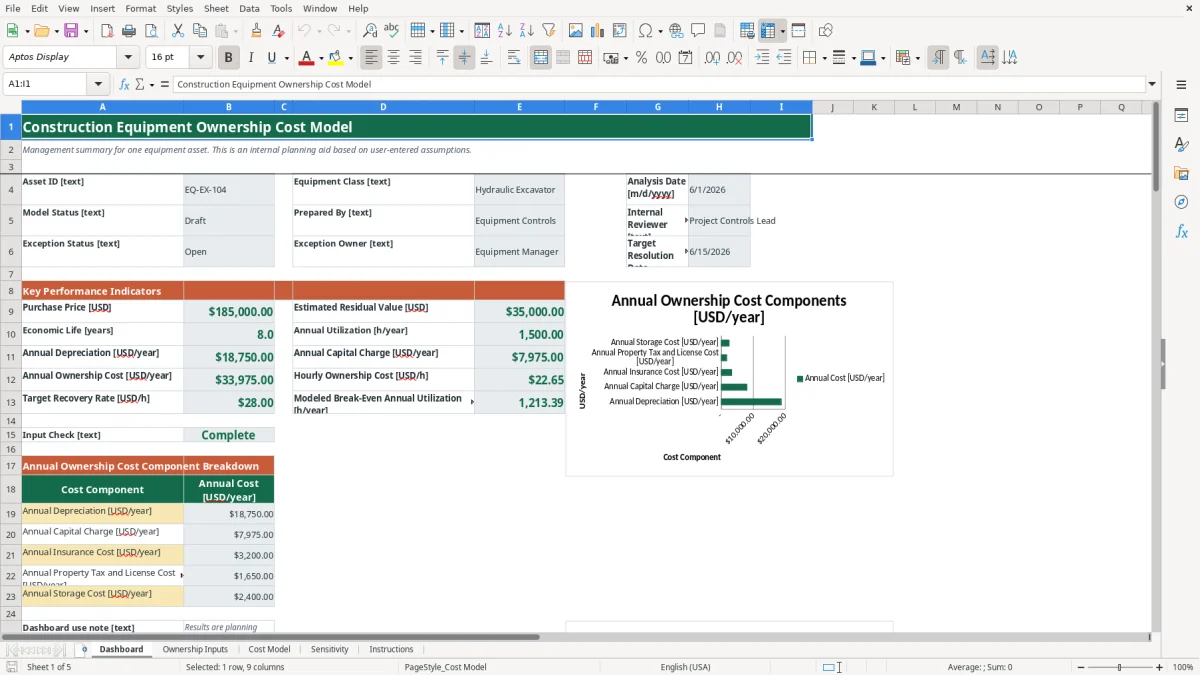
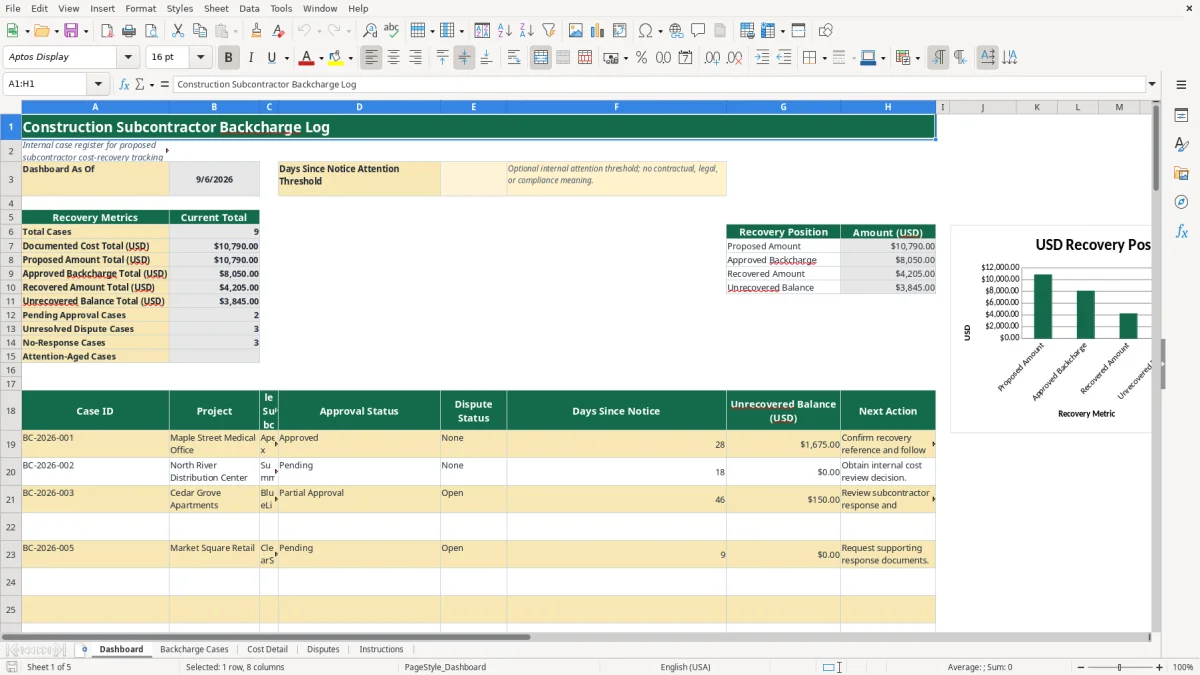
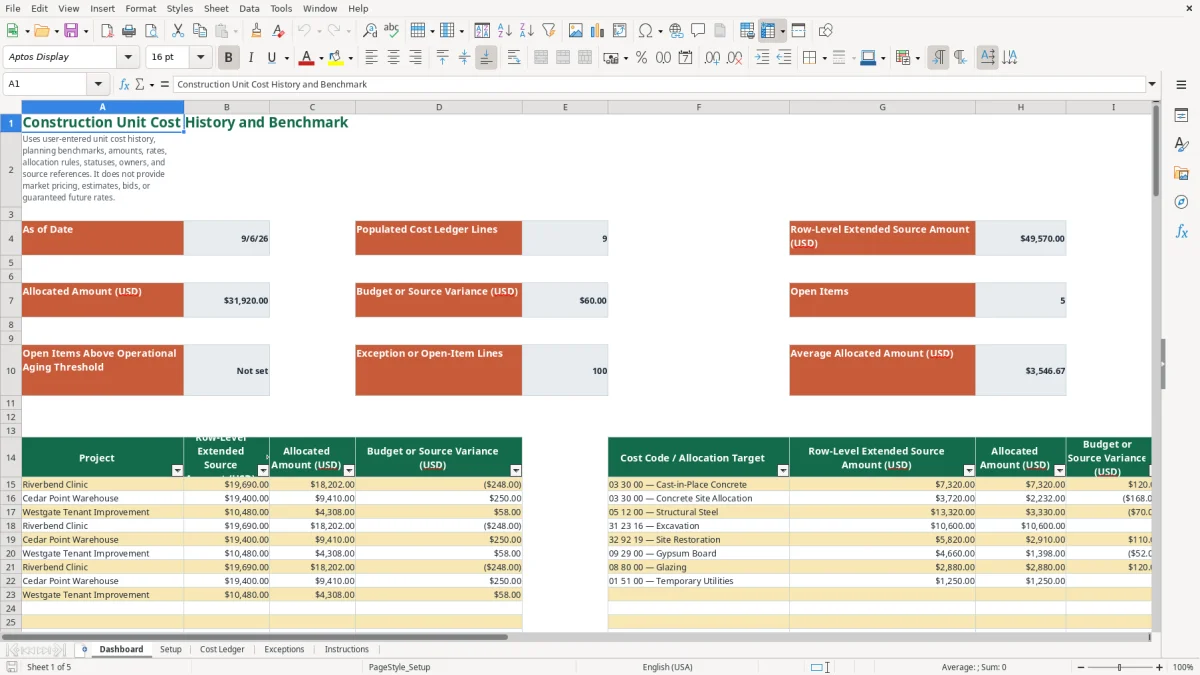
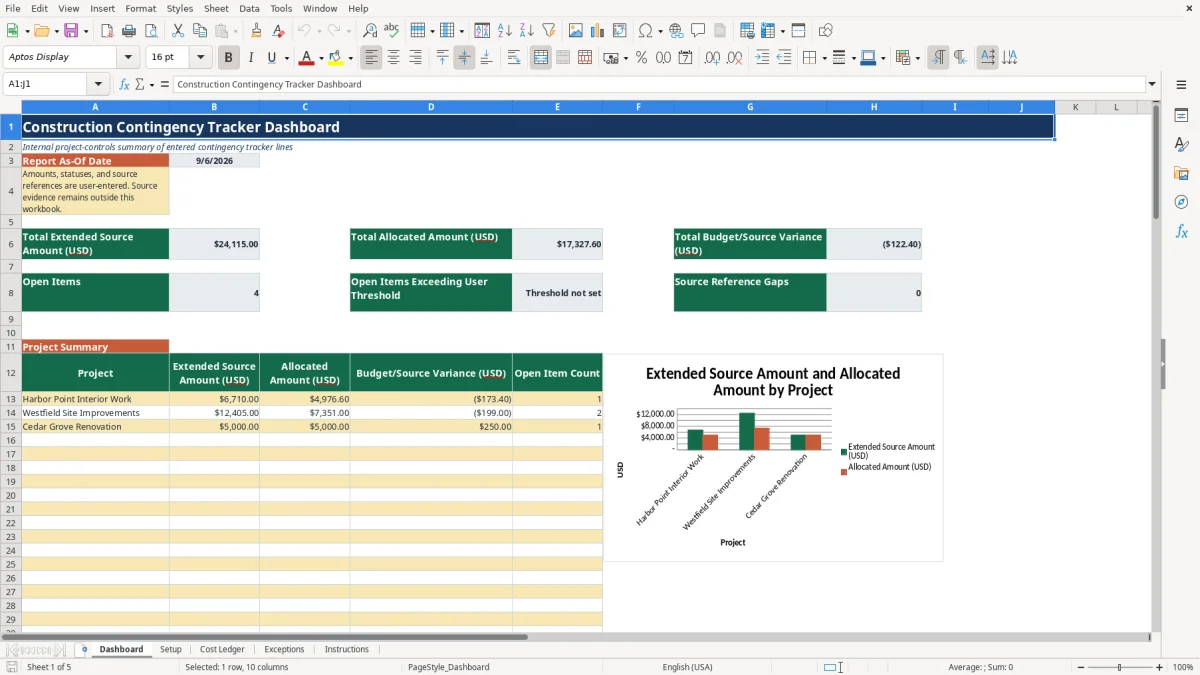
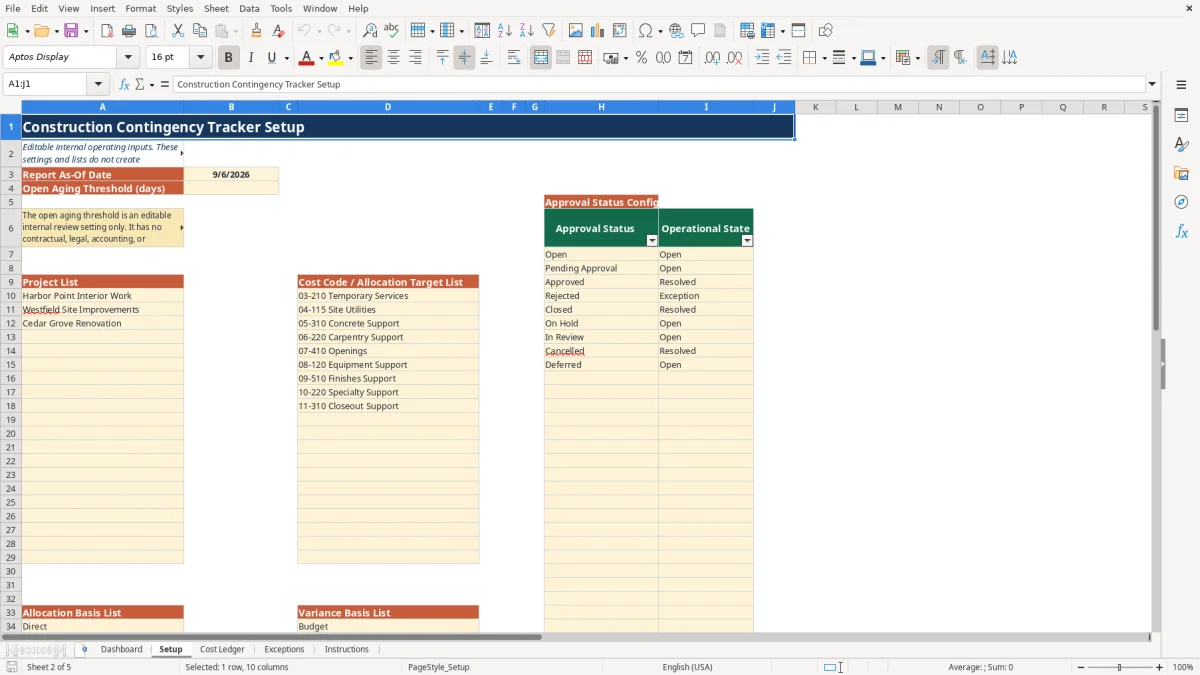
Final workbook preview
Four views generated from the verified XLSX.
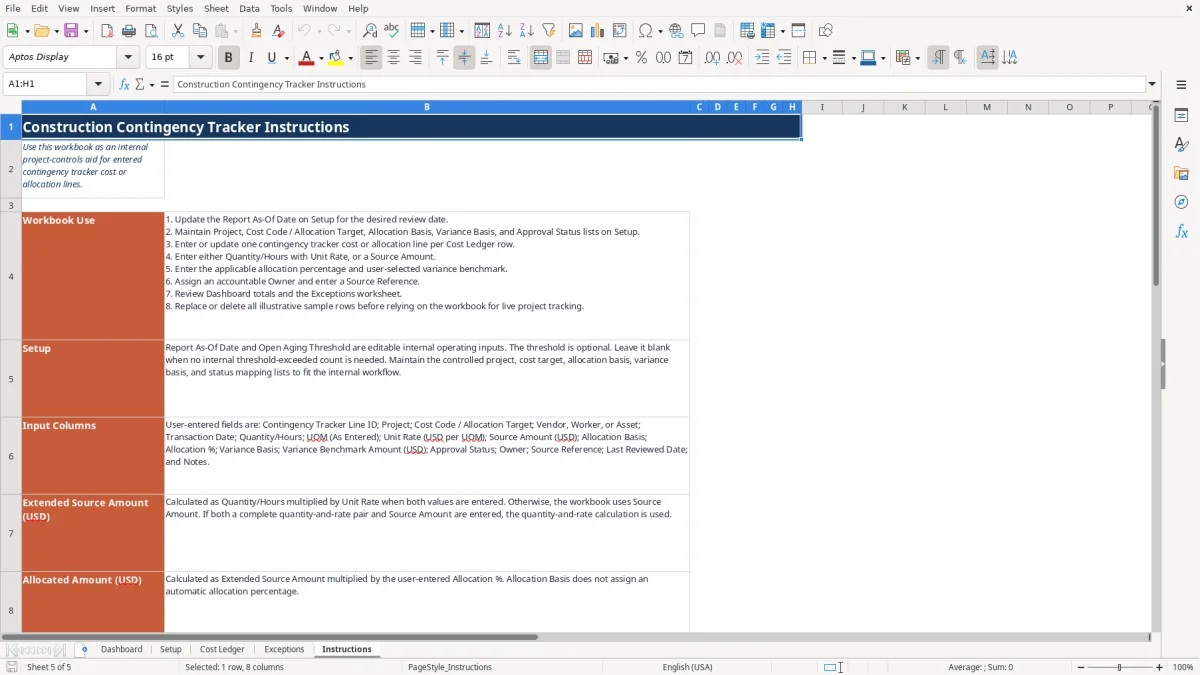
How to use this workbook
Set the review basis
Begin on Setup. Enter or update the Report As-Of Date, which drives open-item aging. You may also enter an Open Aging Threshold in days for an internal count of open items exceeding that threshold. The threshold is optional and is only an internal review setting. Maintain the project, cost code or allocation target, allocation basis, variance basis, and approval-status configuration lists to match the workflow you want to review.
Enter each contingency tracker line
Use the Cost Ledger for one line per contingency tracker cost or allocation record. Enter the line ID, project, cost code or allocation target, vendor, worker, or asset, transaction date, quantity or hours, UOM as entered, unit rate in USD per UOM, or a source amount in USD. Also enter the allocation basis, allocation percentage, variance basis, variance benchmark amount, approval status, owner, source reference, last reviewed date, and notes. Replace or delete the illustrative sample entries before live use.
Check calculated outputs and exceptions
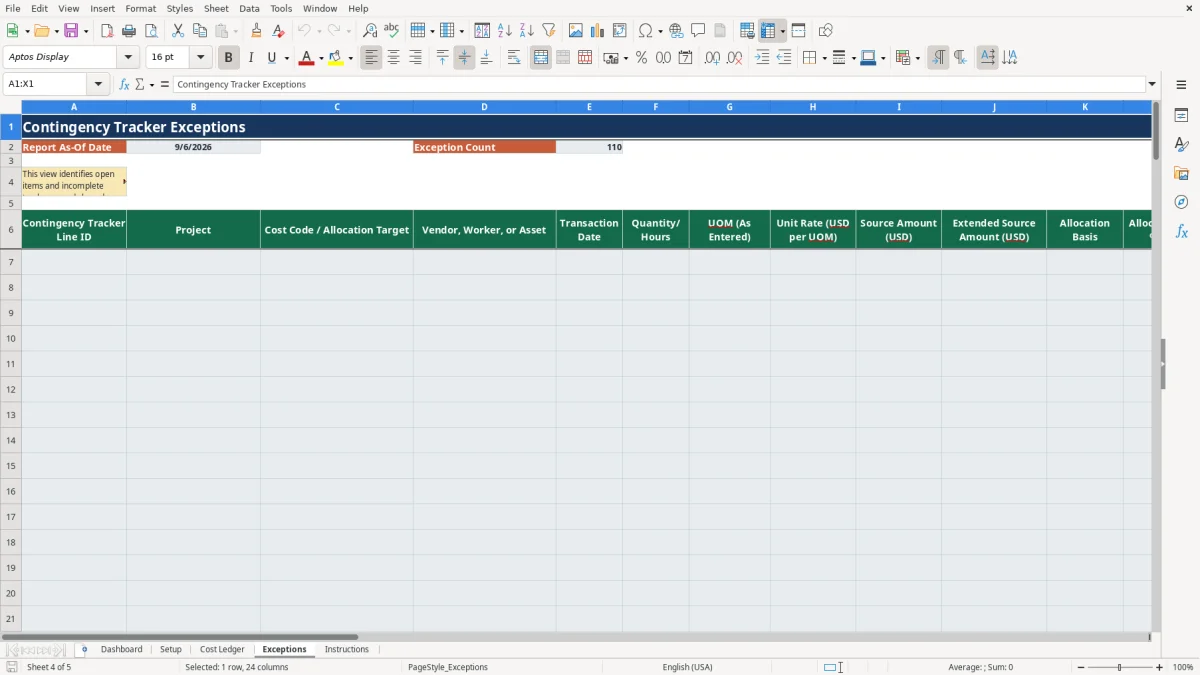
The ledger calculates Extended Source Amount using quantity or hours multiplied by unit rate when both are entered; otherwise it uses the entered source amount. This is one calculation path, not a comparison of both inputs. It also calculates allocated amount, budget or source variance, operational state, open-item aging, and exception detail. Review the Exceptions sheet for corresponding flagged ledger rows, then use the Dashboard for totals and project or cost-code summaries.
Benefits
Keeps contingency tracker cost and allocation lines in one controlled ledger.
Summarizes entered USD amounts by project and cost code or allocation target.
Identifies open, incomplete, unmapped, and review-needed records.
Links each working line to an owner and source reference.
Features
Prepared Cost Ledger rows with user-input fields and calculated status fields.
USD calculations for extended source amount, allocation, and variance.
Setup-based approval-status mapping to open, resolved, or exception states.
Dashboard, Exceptions, Setup, Cost Ledger, and Instructions worksheets.
Construction contingency cost tracking in Excel
This workbook is designed around the contingency tracker cost or allocation line rather than a change item. Each Cost Ledger record can identify the project, cost code or allocation target, vendor, worker, or asset, date, owner, approval status, and source reference. That structure gives a project-controls team one place to maintain its entered working records while keeping supporting source evidence outside the workbook.
The ledger uses prepared rows 6 through 115. It includes lists for several setup-driven fields and date or numeric entry checks for selected columns, but users remain responsible for reviewing entered values and source records.
Calculated USD amounts and variance review
The workbook provides calculated ledger outputs from user-entered values. Extended Source Amount in USD equals Quantity/Hours multiplied by Unit Rate in USD per UOM when both are numeric. If that pair is not complete, the calculation uses Source Amount in USD when provided. If both input approaches are entered, the quantity-and-rate result is used.
Allocated Amount in USD equals Extended Source Amount multiplied by the entered Allocation %. Budget/Source Variance in USD equals Allocated Amount minus the entered Variance Benchmark Amount. A positive variance is above that entered benchmark; a negative variance is below it. The workbook does not determine whether a benchmark is appropriate.
Open-item aging and exception detail
Operational State is calculated from the editable approval-status mapping on Setup. For records mapped to Open, Open Item Aging in days equals the Report As-Of Date minus the entered Transaction Date, with a minimum result of zero. Records not mapped to Open do not receive an aging value.
Exception Detail creates review prompts for missing owners, missing source references, incomplete source amount inputs, unmapped statuses, statuses mapped to Exception, open records, and open records over a numeric aging threshold. The Exceptions worksheet displays the related ledger rows for flagged records. These flags support internal follow-up; they do not determine entitlement, payment, accuracy, or compliance.
Dashboard and operating limits
The Dashboard reports total Extended Source Amount, Allocated Amount, and Budget/Source Variance in USD, along with open-item counts, threshold-exceeded open-item counts when a threshold is set, and source-reference gaps. It also provides project and cost code or allocation target summaries based on ledger entries.
The workbook's Open Aging Threshold is an internal operating input, not a contractual, legal, accounting, or regulatory deadline. This workbook does not replace source systems, field verification, professional judgment, contractual authority, or a construction change-order cost-and-status workflow.
Frequently asked questions
What information do I enter in the contingency tracker workbook?
Enter the identifying and review fields for each line, including line ID, project, cost code or allocation target, vendor, worker, or asset, transaction date, quantities or hours, UOM as entered, rates or source amounts, allocation and variance inputs, approval status, owner, source reference, last reviewed date, and notes.
How does the workbook calculate the extended source amount?
When Quantity/Hours and Unit Rate are both numeric, Extended Source Amount equals their multiplication. Otherwise, the calculation uses the entered Source Amount in USD. If both a complete quantity-and-rate pair and a source amount are present, the quantity-and-rate calculation takes precedence.
Does the allocation basis automatically set the allocation percentage?
No. The Allocation Basis is a user-entered classification, while Allocation % is a separate user-entered value from 0% through 100%. The workbook does not assign a percentage automatically. Allocated Amount equals Extended Source Amount multiplied by the entered percentage.
What creates an exception record?
A ledger row appears in the Exceptions worksheet when its Exception Detail is not blank. The detail can flag missing owner or source reference information, incomplete amount inputs, an unmapped approval status, a status mapped to Exception, an open item, or an open item beyond the optional aging threshold.
Can this workbook manage change orders or serve as source evidence?
No. It records contingency tracker cost or allocation lines and calculated internal review views. Source evidence remains outside the workbook, and the workbook does not manage change items or replace a separate change-order cost-and-status process, contractual review, or professional judgment.
Workbook file
Ready to put this workbook to work?
Download the verified XLSX, keep an untouched copy, and adapt a working copy to your project.
Download verified XLSXEditorial team
About the authors

Paige Sutton Vale
Workbook Systems Editor
Paige turns construction planning, cost-control, field, and closeout workflows into clear Excel workbook guides. She focuses on inputs, calculations, outputs, and practical limits.

Maren Ellsworth Keel
Workbook QA Reviewer
Maren reviews formula behavior, field labels, project-controls terminology, and workbook instructions so each resource stays within its documented scope.