Verified Excel workbook
Free 2026 Construction AP Aging Workbook in Excel
Track construction AP aging in Excel with user-entered dates, amounts, allocations, owners, and exception views for focused 2026 review.
Download the Free 2026 Construction Accounts Payable Aging Workbook in Excel for a controlled internal register of outstanding AP cost or allocation lines. The workbook separates user entry from calculated review: Setup holds operating settings and reference lists, Cost Ledger holds the records, Dashboard summarizes results, and Exceptions identifies unresolved flagged records.
Use it to organize project, cost-code, vendor, transaction-date, responsibility, and source-reference details in a single control record. It supports internal project-controls review using user-entered data and assumptions. Source evidence remains outside the workbook, and the workbook does not replace source systems, professional judgment, field verification, contractual authority, or regulatory determinations.
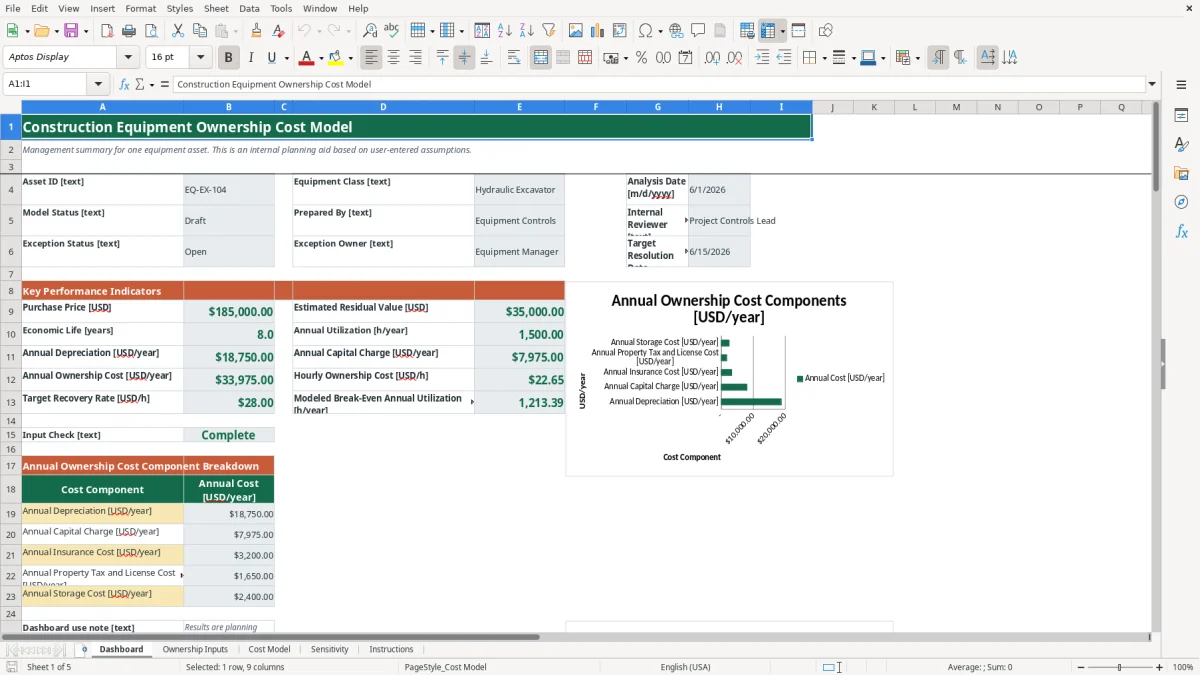
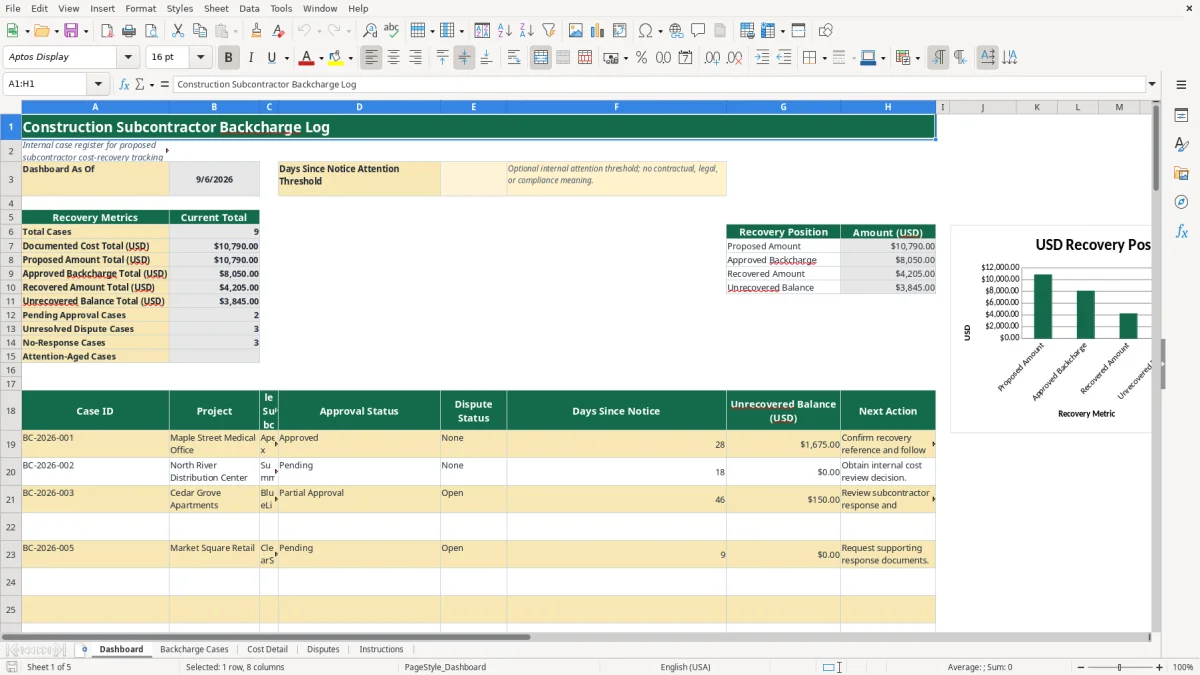
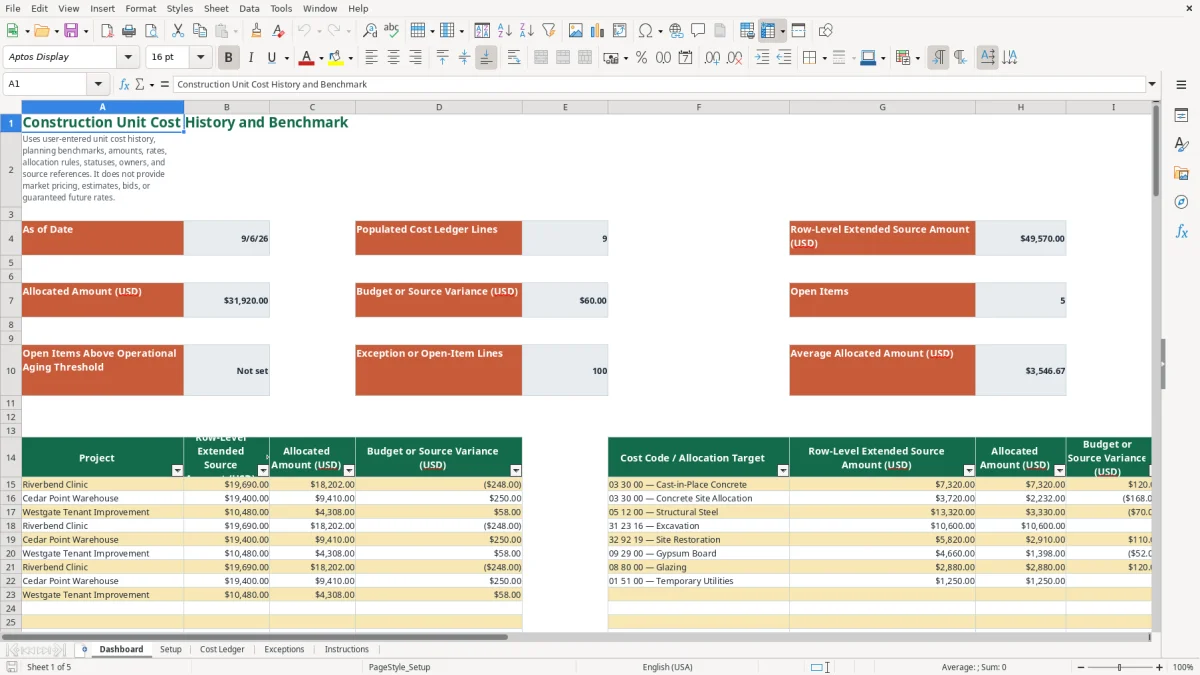
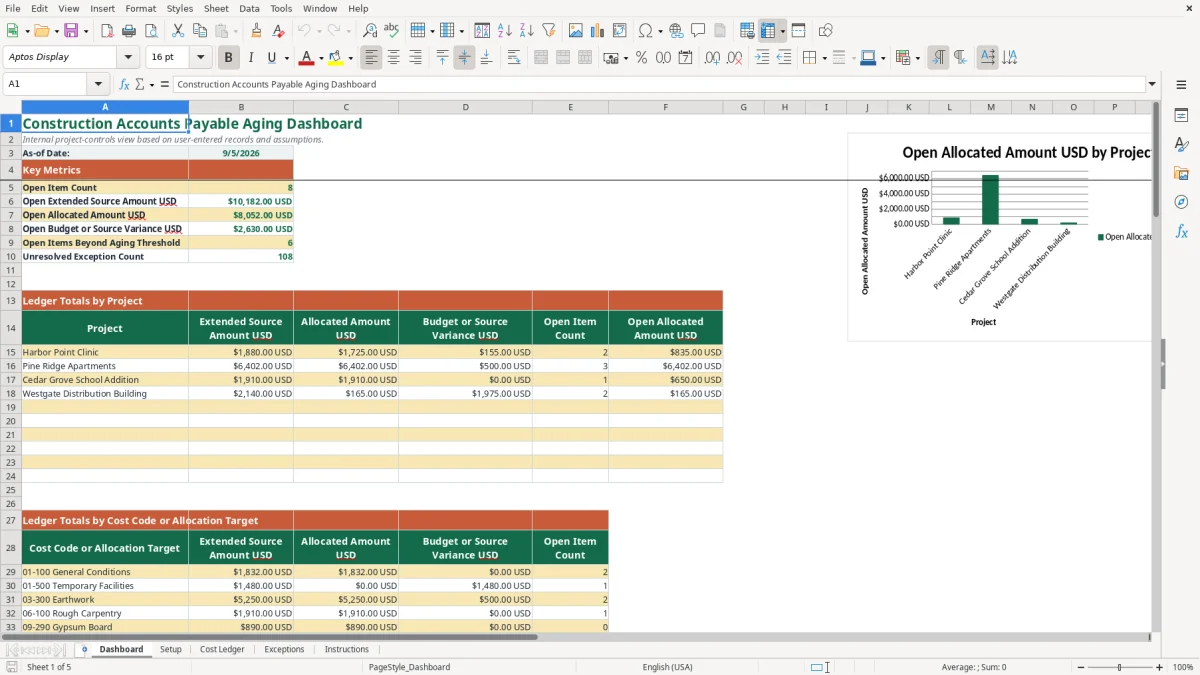
Final workbook preview
Four views generated from the verified XLSX.
How to use this workbook
Update the Setup sheet
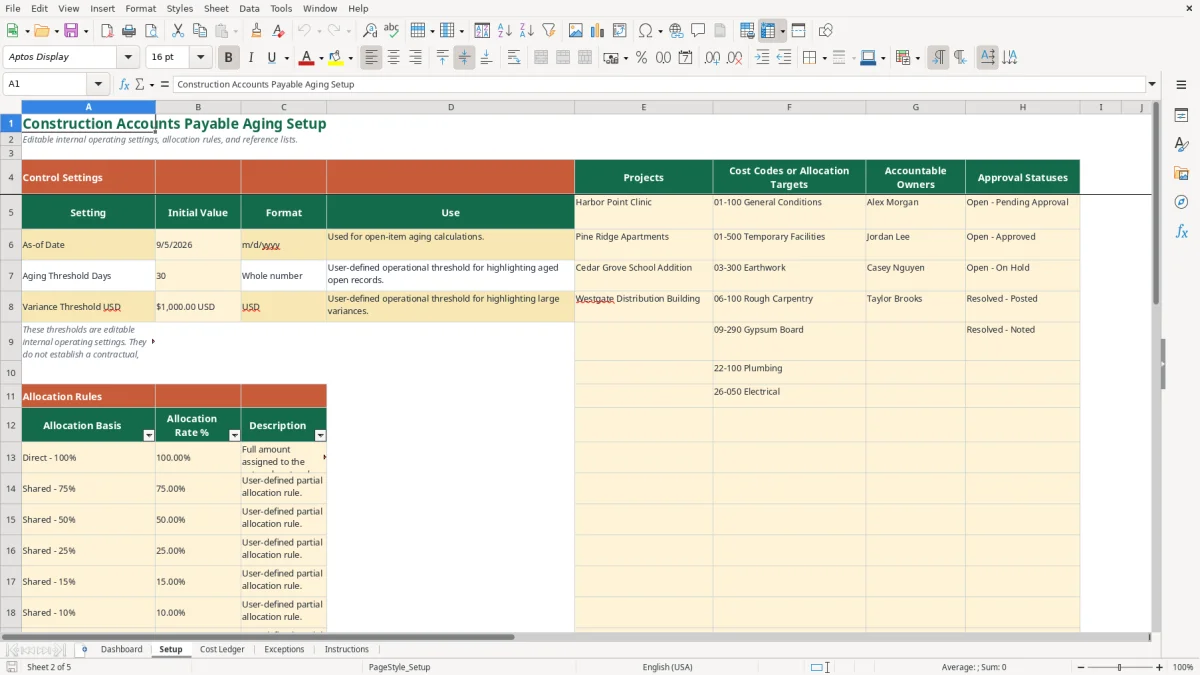
Enter the working As-of Date, aging threshold days, and variance threshold in Setup. Maintain the project, cost code or allocation target, accountable owner, approval-status, and allocation-rule lists used by the ledger. These are editable internal operating settings, not contractual or regulatory requirements.
Enter one ledger record per line
On Cost Ledger, enter a unique one line ID per record, project, cost code or allocation target, vendor, worker, or asset, transaction date, unit of measure, approval status, accountable owner, and source reference. Enter either Quantity or Hours with Unit Rate USD, or enter Source Amount USD. The workbook does not convert units; enter the intended unit of measure directly.
Select an allocation basis
Select an allocation basis that matches an editable Setup allocation rule. The ledger retrieves the related allocation rate percentage. Enter Budget or Comparison Baseline USD only when your team needs a user-defined comparison amount. The Cost Ledger includes populated sample records, including AP-0001 and AP-0002, which should be reviewed before operational use.
Review calculated results and follow up
Review the calculated fields for extended source amount, allocated amount, budget or source variance, open-item aging days, and exception flags. Use Dashboard for summarized review and Exceptions for non-resolved records with flags. Correct the applicable Cost Ledger input rather than manually entering an exception record.
Benefits
Keep open accounts payable aging records organized by project and cost code or allocation target.
Assign an accountable owner and source reference to each entered ledger line.
Review open-item aging, allocated amounts, and variance results from one dashboard.
Focus follow-up on unresolved records with calculated operational exception flags.
Features
Five worksheets: Dashboard, Setup, Cost Ledger, Exceptions, and Instructions.
A Cost Ledger entry area prepared for accounts payable aging lines through row 114.
Calculated extended source amount, allocated amount, variance, and open-item aging days.
Dashboard totals by project, cost code or allocation target, and allocation basis.
Construction accounts payable aging control in Excel
This workbook is built around one accounts payable aging cost or allocation line per Cost Ledger row. User-entered fields include the project, cost code or allocation target, vendor, worker, or asset, transaction date, unit of measure, quantity or hours, unit rate USD, source amount USD, allocation basis, approval status, accountable owner, and source reference. This approach keeps the operational record connected to the person responsible for follow-up.
For each record, enter either a source amount in USD or a quantity or hours value with a unit rate in USD. The calculation uses Source Amount USD when it is entered; otherwise, it multiplies Quantity or Hours by Unit Rate USD. The worksheet does not infer units, rates, dates, or missing source evidence.
Allocation and variance review
The Setup sheet includes an Allocation Rules table where users maintain an allocation basis and allocation rate percentage. When an allocation basis is selected in Cost Ledger, the allocation rate is retrieved from that rule. Allocated Amount USD is calculated as Extended Source Amount USD multiplied by the allocation rate percentage.
Budget or Source Variance USD is calculated as Budget or Comparison Baseline USD less Allocated Amount USD when a baseline is entered. If no baseline is entered, the calculation uses Extended Source Amount USD less Allocated Amount USD. This is a user-defined comparison, not a determination of invoice validity, entitlement, or payment status.
Aging dashboard and unresolved exceptions
The Dashboard reports open item count, open extended source amount in USD, open allocated amount in USD, open budget or source variance in USD, open items beyond the aging threshold, and unresolved exception count. It also presents ledger totals by project, cost code or allocation target, and allocation basis. The as-of date and thresholds originate from Setup.
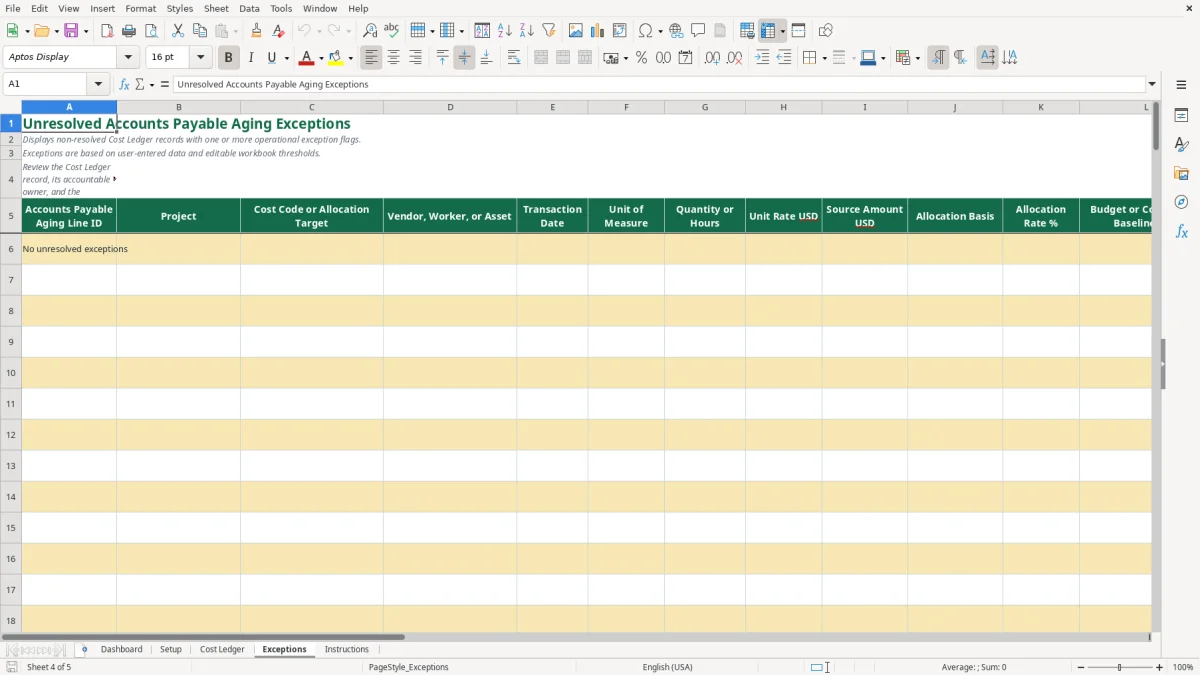
Open-Item Aging Days is calculated from Transaction Date through the user-entered as-of date only for approval statuses beginning with Open. Exceptions displays non-resolved Cost Ledger records that have one or more calculated exception flags. Missing transaction date, approval status, accountable owner, or source reference can appear as flags and should prompt operational follow-up against the referenced evidence outside the workbook.
Frequently asked questions
What worksheets are included in this workbook?
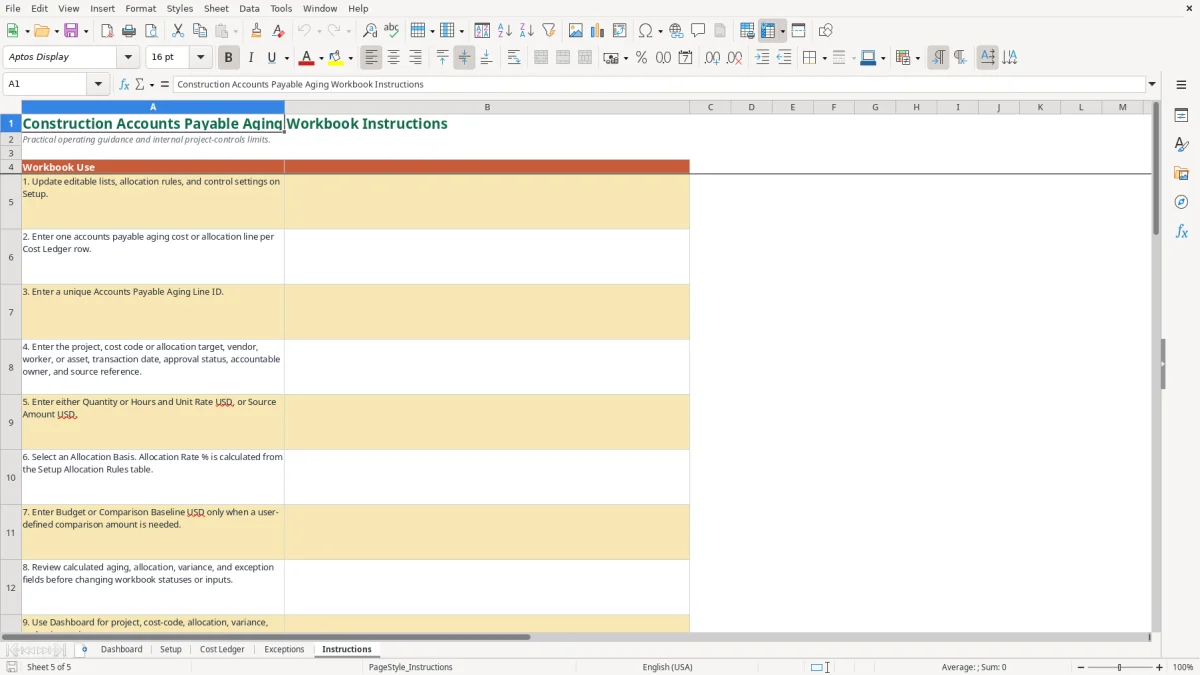
The workbook contains Dashboard, Setup, Cost Ledger, Exceptions, and Instructions. Dashboard provides calculated summary views, Setup contains editable settings and reference lists, Cost Ledger is the controlled input register, Exceptions shows unresolved flagged records, and Instructions explains the workflow and calculation definitions.
How does the workbook calculate accounts payable aging?
For records with an approval status beginning with Open, Open-Item Aging Days equals the elapsed days from the entered Transaction Date through the Setup as-of date. The user enters the as-of date and aging threshold days. Resolved statuses do not receive an open-item aging result.
What information must users enter?
Users enter the line ID, project, cost code or allocation target, vendor, worker, or asset, transaction date, unit information, amount inputs, allocation basis, approval status, accountable owner, and source reference. A budget or comparison baseline in USD is optional when a comparison amount is needed.
Can the workbook determine whether an invoice should be paid?
No. The workbook is an internal project-controls aid for organizing user-entered records and calculated status views. It does not certify payment, accuracy, entitlement, compliance, or contractual authority. Review source evidence and use appropriate professional judgment before changing a status, amount, date, or allocation rule.
Workbook file
Ready to put this workbook to work?
Download the verified XLSX, keep an untouched copy, and adapt a working copy to your project.
Download verified XLSXEditorial team
About the authors

Paige Sutton Vale
Workbook Systems Editor
Paige turns construction planning, cost-control, field, and closeout workflows into clear Excel workbook guides. She focuses on inputs, calculations, outputs, and practical limits.

Maren Ellsworth Keel
Workbook QA Reviewer
Maren reviews formula behavior, field labels, project-controls terminology, and workbook instructions so each resource stays within its documented scope.