Verified Excel workbook
Free Construction Allowance Workbook in Excel for 2026
Track construction allowance cost and allocation lines in Excel with USD totals, open-item aging, variance, and exception views for 2026 projects.
Download this free Construction Allowance Tracker Workbook in Excel for a practical internal register of allowance cost and allocation lines. Record a line ID, project, cost code or allocation target, vendor, worker, or asset, transaction date, accountable owner, approval status, and source reference in one place. One line represents one allowance record.
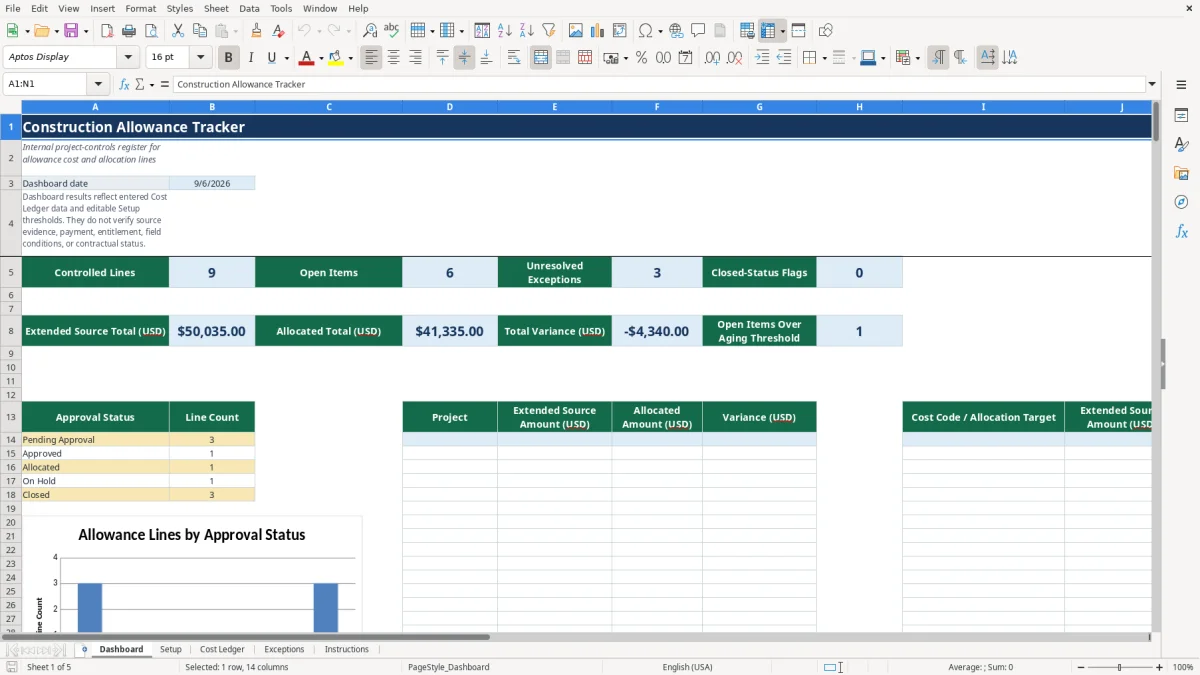
The workbook calculates extended source amounts, allocated amounts, budget or source variance in USD, and open-item aging in days from entered data. Dashboard summarizes controlled lines, open items, exception counts, and totals, while Exceptions shows calculated unresolved items for follow-up. Source evidence remains outside the workbook.
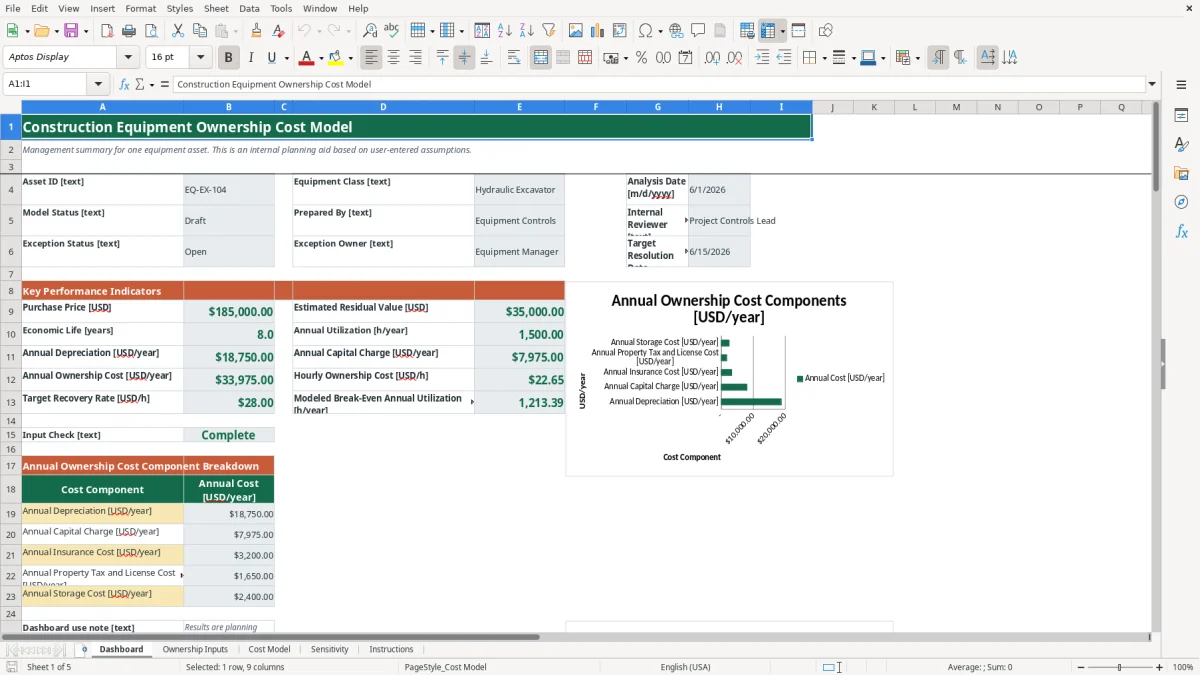
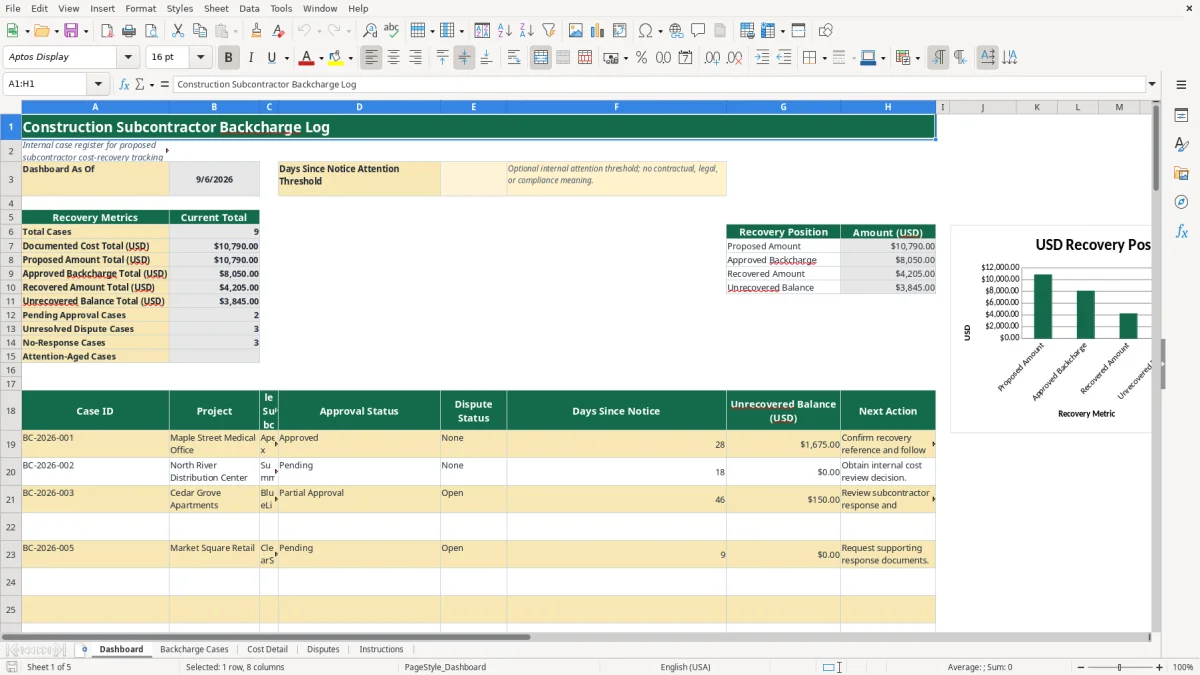
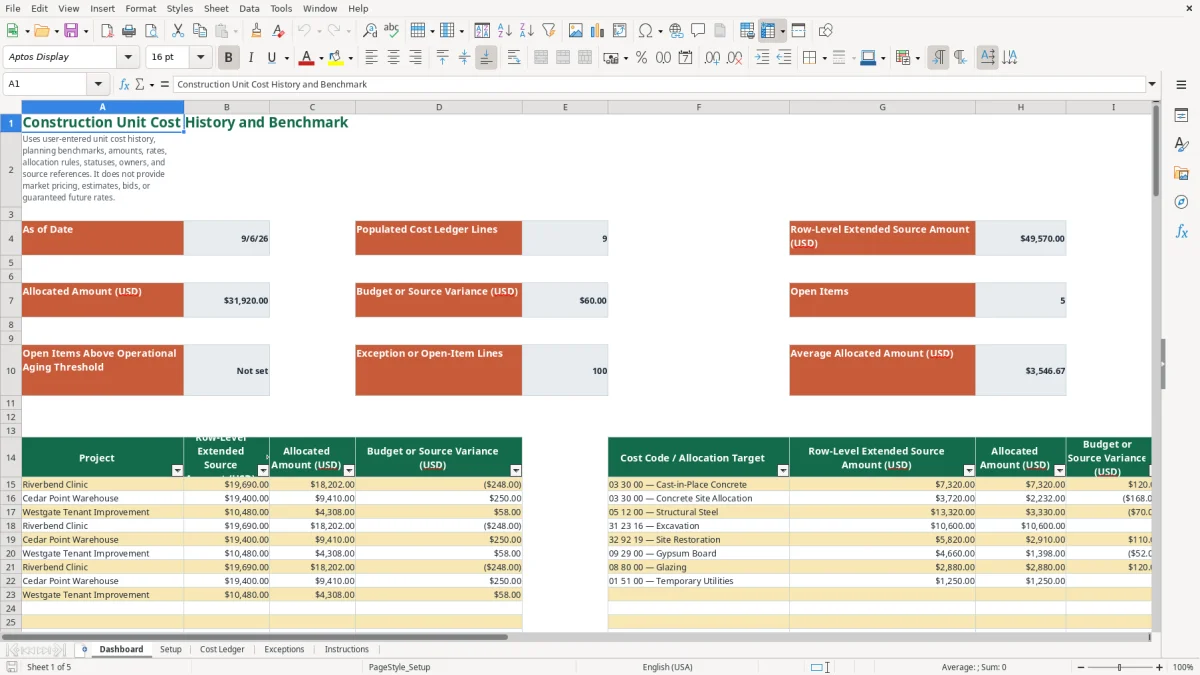
Final workbook preview
Four views generated from the verified XLSX.
How to use this workbook
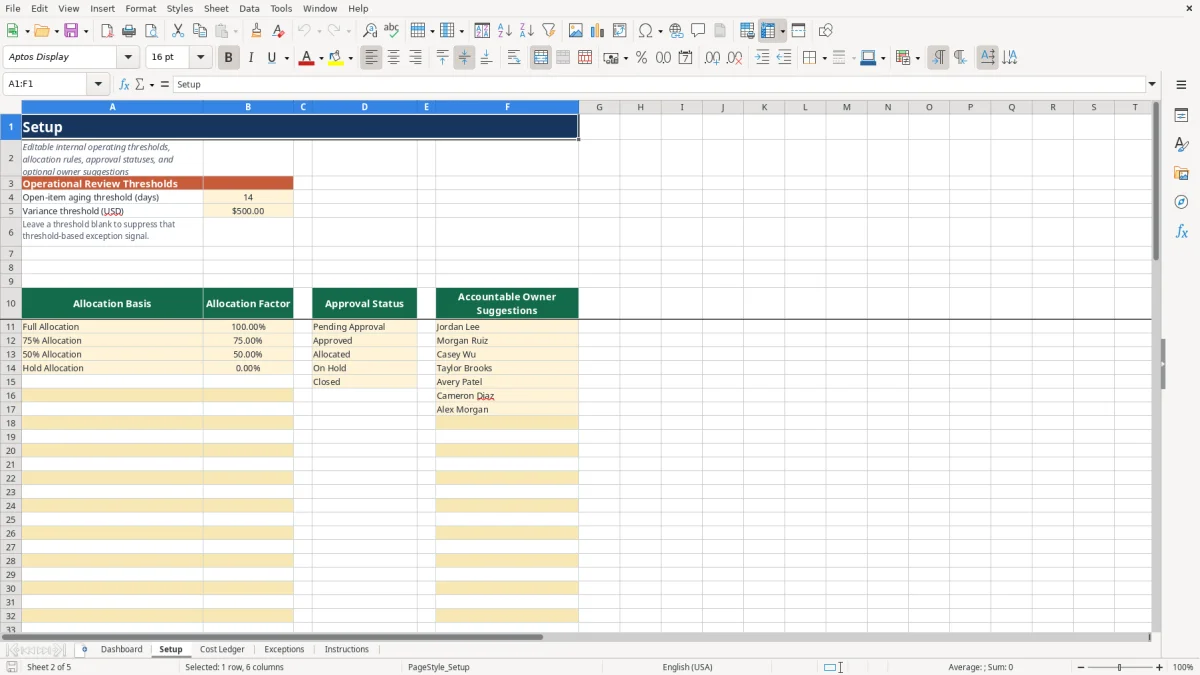
Set internal review rules
On Setup, revise the internal open-item aging threshold in days and variance threshold in USD as needed. The sheet also holds editable allocation bases and factors, approval statuses, and optional owner suggestions. Leave a threshold blank to suppress its related threshold-based exception signal.
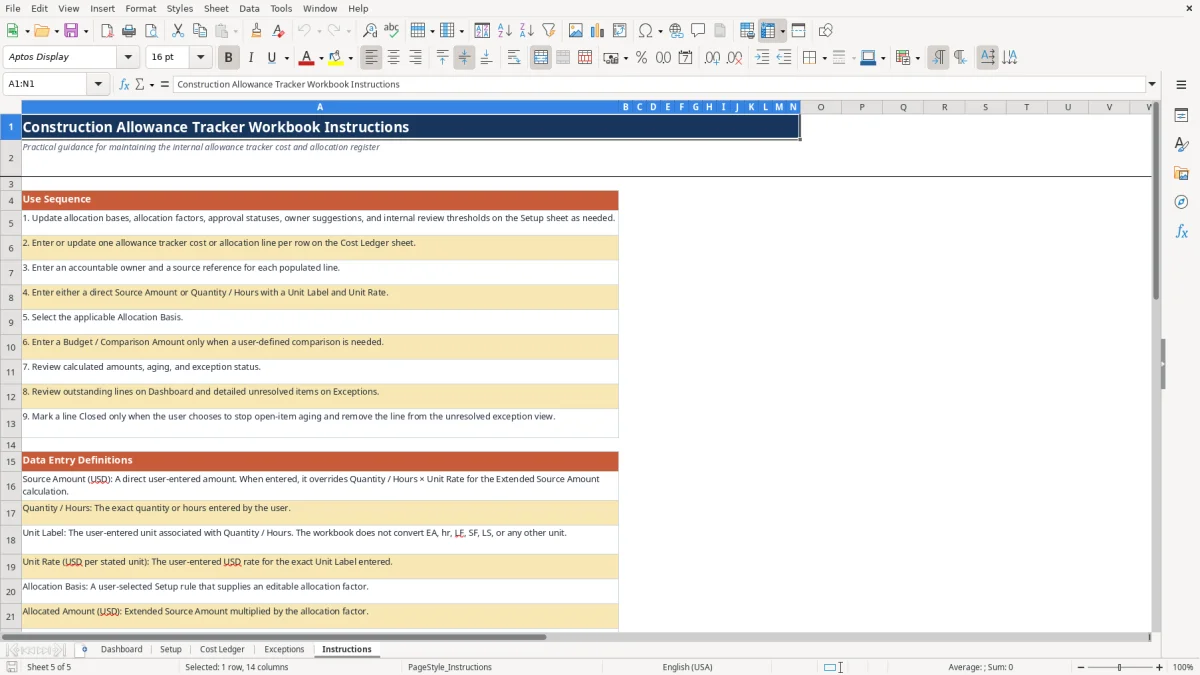
Enter a controlled ledger line
On Cost Ledger, enter one line ID, project, cost code or allocation target, vendor, worker, or asset, transaction date in m/d/Y format, accountable owner, approval status, and source reference. Enter either a direct Source Amount (USD) or Quantity / Hours, Unit Label, and Unit Rate (USD per stated unit). Do not treat the unit label as a conversion field.
Select allocation and comparison inputs
Choose an Allocation Basis from the Setup list. Its factor is used in the allocated amount calculation. Enter Budget / Comparison Amount (USD) only when your team wants a user-defined comparison. The source reference should point users to evidence maintained outside the workbook.
Review calculated results
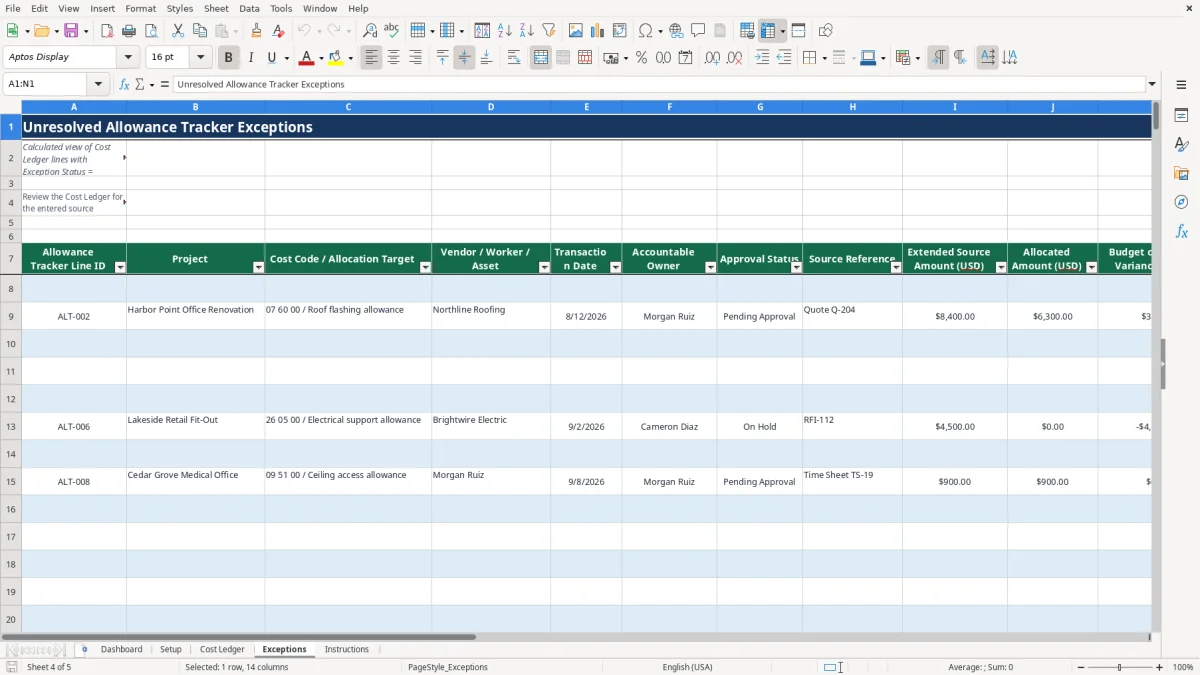
Review calculated columns for extended source amount, allocated amount, variance basis, budget or source variance, aging, missing required input, exception reason, and exception status. Use Dashboard for totals and counts, then Exceptions for unresolved-line detail. Marking a line Closed stops aging and removes it from the unresolved view; Closed is a user-entered status.
Benefits
Maintain allowance cost and allocation lines by project and cost-code target.
Assign owners, statuses, dates, and source references for each record.
Review calculated USD amounts, variance, aging, and exception status.
Use unresolved items to organize internal follow-up discussions and assignments.
Features
Five worksheets: Dashboard, Setup, Cost Ledger, Exceptions, and Instructions.
Cost Ledger includes 250 prepared operational rows for controlled entries.
Calculated fields cover extended source amount, allocation, variance, aging, and exceptions.
Dashboard summarizes USD totals and line counts by project and allocation target.
What the allowance tracker controls
This workbook controls allowance tracker cost or allocation lines, not selection items or a broad job-cost system. The primary record is a line with an identifier, project, cost code or allocation target, vendor, worker, or asset, transaction date, allocation basis, owner, approval status, and source reference. Cost Ledger is the controlled input register, while Dashboard provides calculated status summaries.
Use it to organize a consistent internal review record across projects and cost-code targets. The workbook does not store or validate invoices, quotes, purchase orders, or other evidence. A source reference is a user-entered pointer to material maintained outside the workbook.
Source amount and allocation calculations
Extended Source Amount (USD) uses a direct Source Amount (USD) when one is entered. Otherwise, it uses Quantity / Hours multiplied by Unit Rate (USD per stated unit) when the required inputs are present. The workbook retains the exact user-entered Unit Label; it does not convert EA, hr, LF, SF, LS, or other labels.
Allocated Amount (USD) equals Extended Source Amount multiplied by the factor tied to the selected Allocation Basis on Setup. The included allocation bases and factors are editable internal inputs. Use only your team’s entered factors and assumptions. Review the selected basis before relying on an allocated amount.
Variance, aging, and exception review
When a Budget / Comparison Amount (USD) is entered, Budget or Source Variance (USD) equals Allocated Amount less that amount. Without a comparison amount, variance equals Allocated Amount less Extended Source Amount. For a line not marked Closed, Open-Item Aging (Days) counts calendar days from the Transaction Date through the current Excel date.
Dashboard reports controlled lines, open items, unresolved exceptions, closed-status flags, USD totals, and items above the Setup aging threshold. Exceptions displays calculated unresolved lines with key ledger information, amounts, aging, and the exception reason. These are internal review signals, not determinations.
Functional limits for project controls
This workbook is an internal project-controls aid for organizing entered allowance records and calculated status views. It does not replace source systems, professional judgment, field verification, contractual authority, or regulatory determinations. It does not certify entitlement, payment, accuracy, compliance, or contractual status.
A Closed status stops the workbook’s aging calculation and removes that line from the unresolved exception view. It does not establish resolution outside the workbook. The prepared ledger range contains 250 operational rows; expanding it requires extending the ledger table, calculated columns, data-validation ranges, and related references.
Frequently asked questions
What do I enter for each allowance line?
Enter the Line ID, project, cost code or allocation target, vendor, worker, or asset, transaction date, allocation basis, accountable owner, approval status, and source reference. For the amount, enter either Source Amount (USD) or Quantity / Hours with a Unit Label and Unit Rate (USD per stated unit). Budget / Comparison Amount (USD) is optional.
How does the workbook calculate the source amount?
If you enter Source Amount (USD), the workbook uses it for Extended Source Amount (USD). If it is blank, the workbook uses Quantity / Hours multiplied by Unit Rate (USD per stated unit) when the required inputs are present. A direct source amount takes precedence.
Can I change allocation factors and thresholds?
Yes. Setup contains editable allocation bases and factors, approval statuses, optional owner suggestions, and internal thresholds for aging in days and variance in USD. Leaving a threshold blank suppresses its related threshold-based exception signal. These settings do not create external deadlines or requirements.
What happens when I mark a line Closed?
Closed is a user-entered approval status. The workbook stops open-item aging for that line and does not include it in the unresolved exception view. A closed-status exception can still be counted on Dashboard. Closing a line does not verify evidence or resolution.
Does this replace accounting or contract administration?
No. The workbook organizes user-entered allowance records and calculated internal views. It does not replace accounting systems, contract administration, source documentation, field verification, or professional judgment. Review underlying project records and evidence before making operational, financial, or contractual decisions.
Workbook file
Ready to put this workbook to work?
Download the verified XLSX, keep an untouched copy, and adapt a working copy to your project.
Download verified XLSXEditorial team
About the authors

Paige Sutton Vale
Workbook Systems Editor
Paige turns construction planning, cost-control, field, and closeout workflows into clear Excel workbook guides. She focuses on inputs, calculations, outputs, and practical limits.

Maren Ellsworth Keel
Workbook QA Reviewer
Maren reviews formula behavior, field labels, project-controls terminology, and workbook instructions so each resource stays within its documented scope.