Verified Excel workbook
Free 2026 Subcontractor Mobilization Workbook in Excel
Free 2026 subcontractor mobilization schedule workbook in Excel tracks planned dates, responsible parties, status, constraints, and exceptions.
Use this workbook to maintain subcontractor mobilization activities, milestones, dates, accountable parties, and unresolved issues in one internal register. Download the Free 2026 Workbook in Excel to enter an item ID, project, activity or milestone, responsible party, planned dates, dependency or constraint, actual finish date, status, and source reference. The workbook keeps schedule entries and calculated review results together while supporting routine project-controls discussions.
It is intended for user-entered schedule records, not for confirming field conditions or replacing source documentation. Review current project information before acting on a Dashboard or Exceptions result. The reporting as-of date and upcoming window are user-controlled settings, allowing teams to establish the review period used by calculated schedule views.
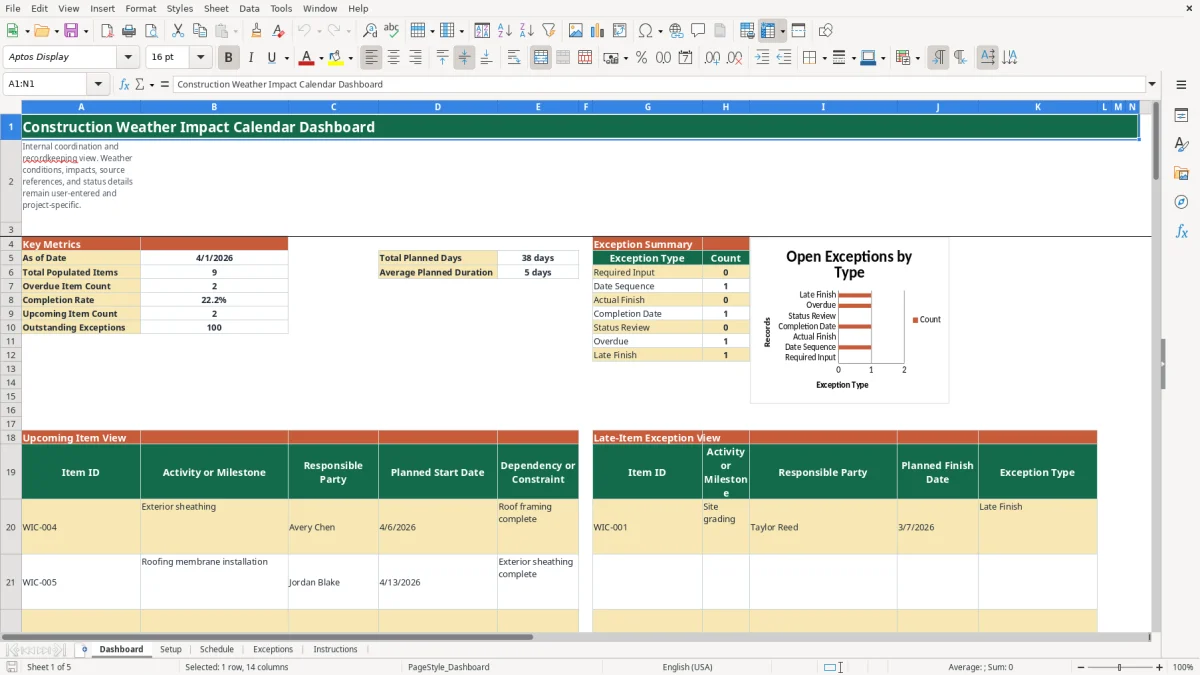
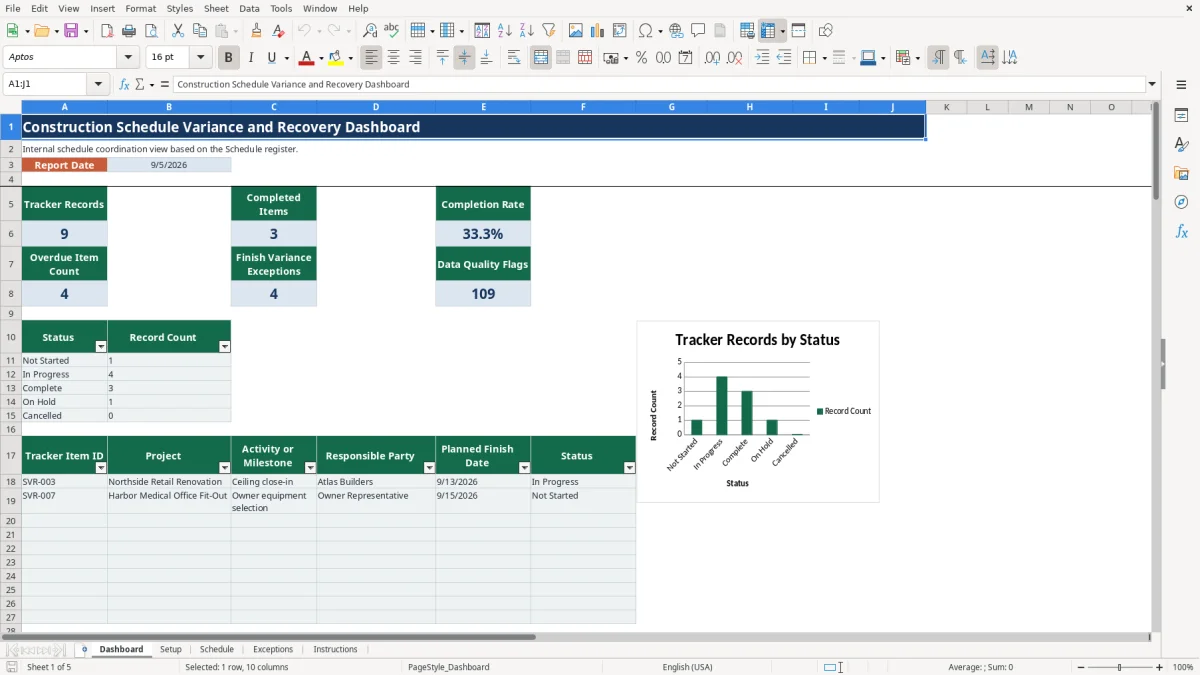
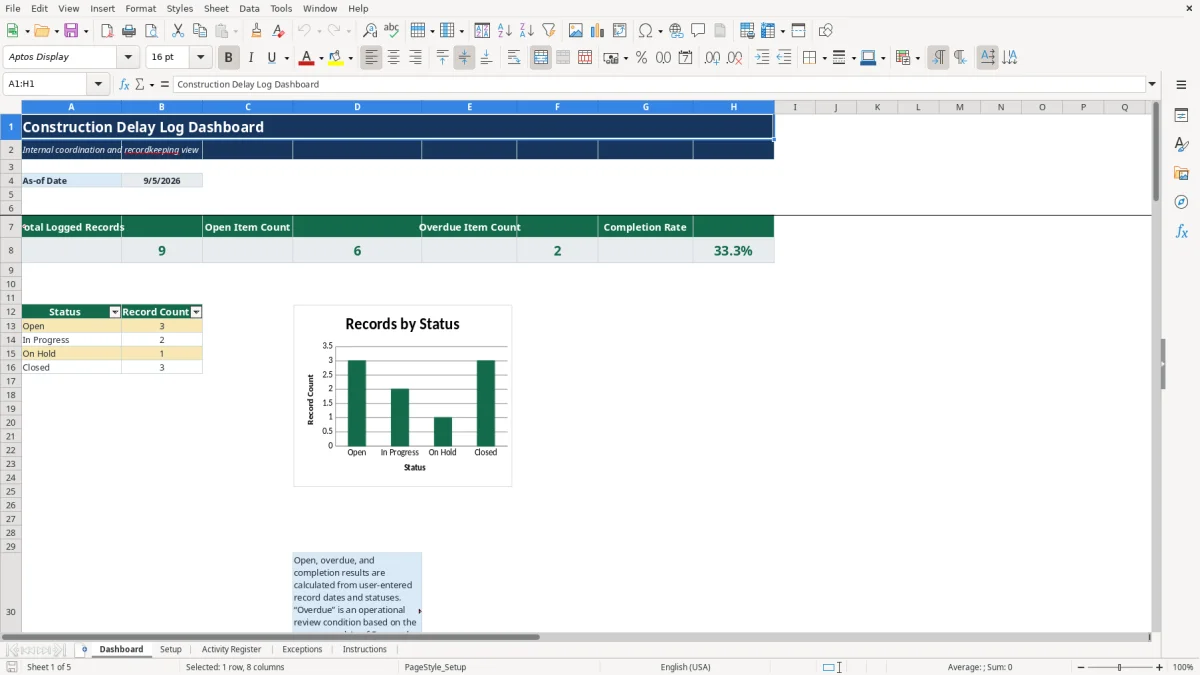
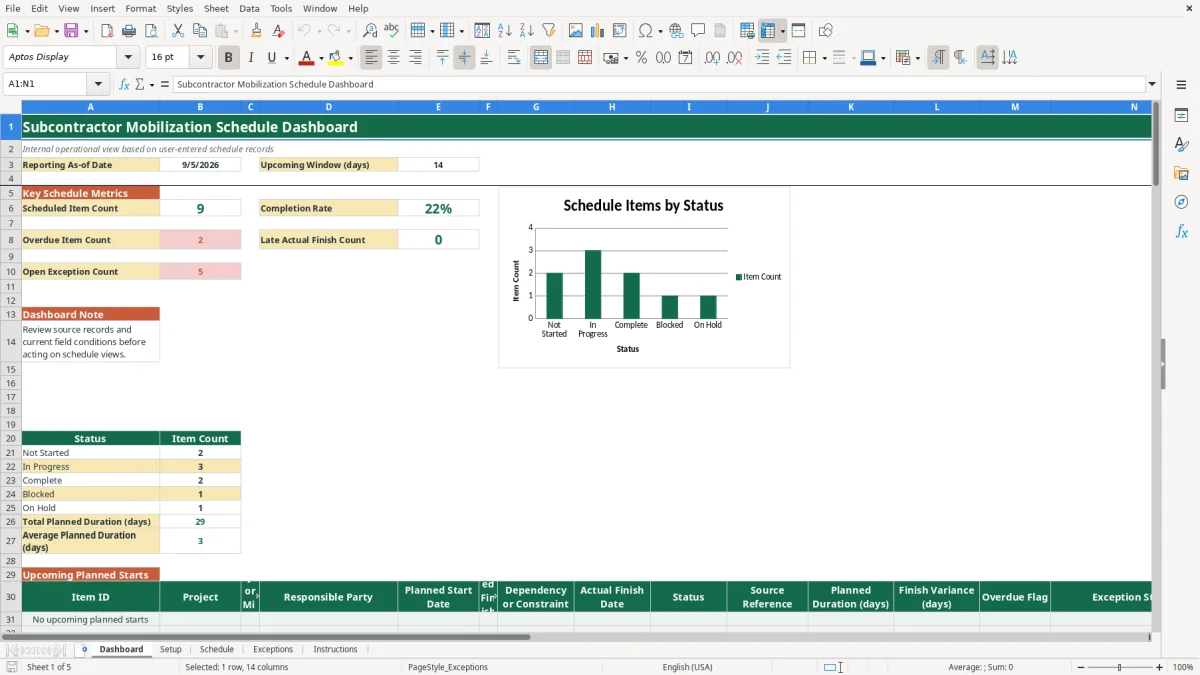
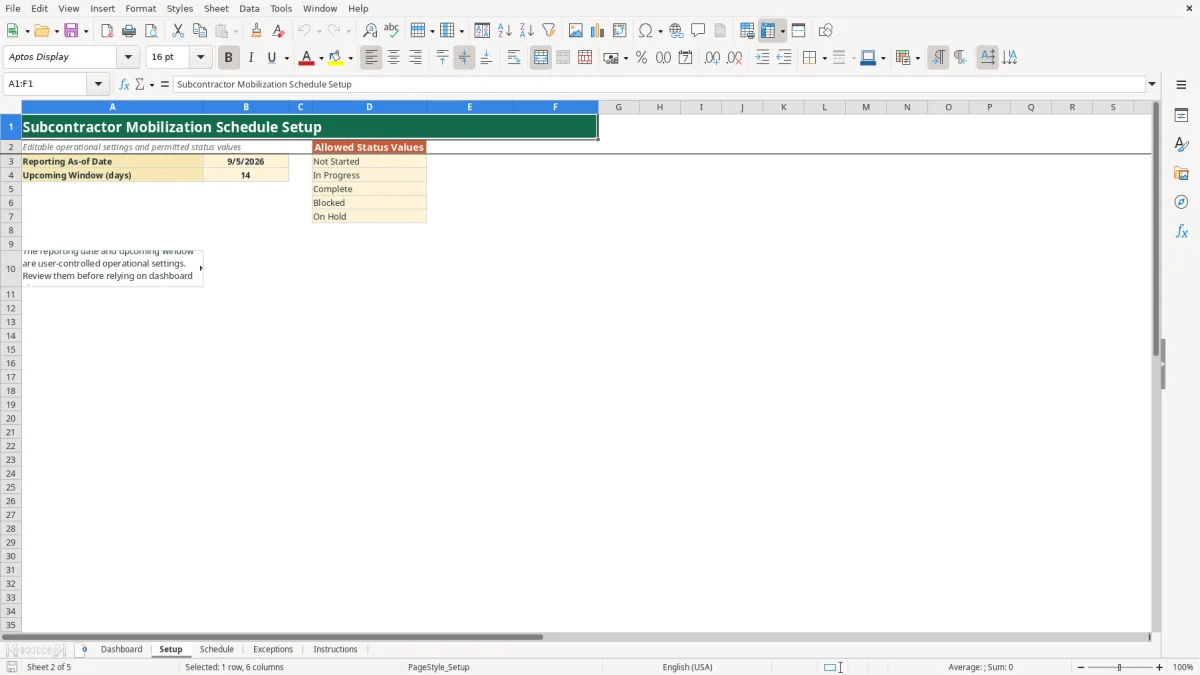
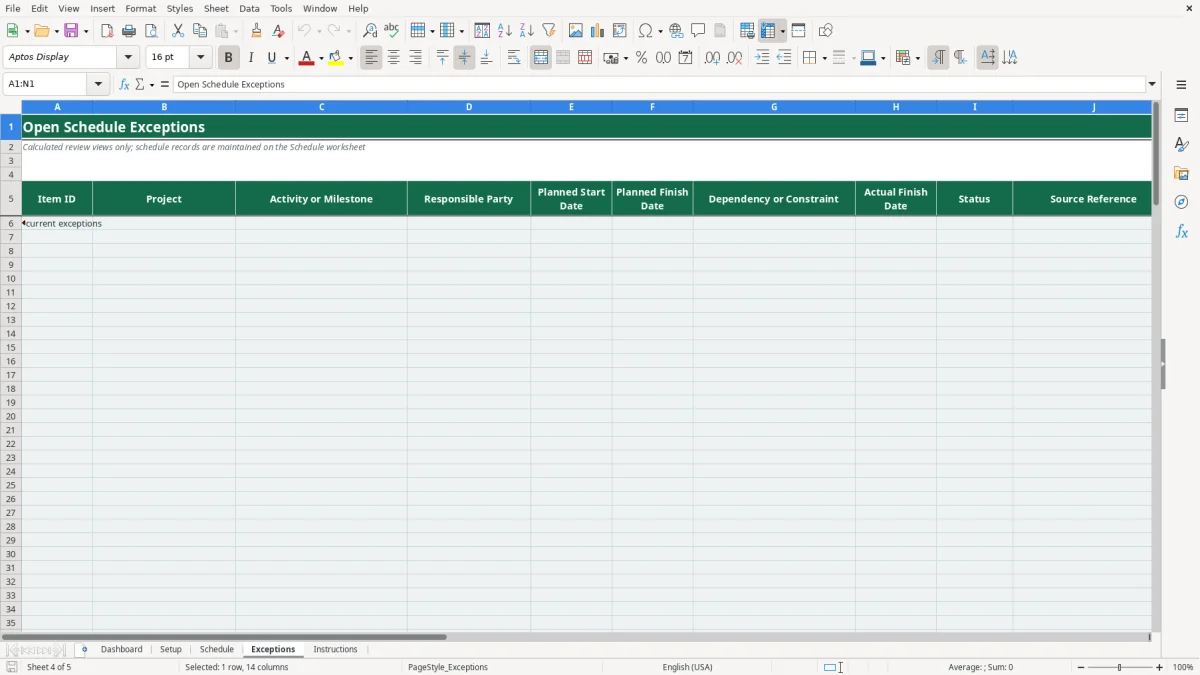
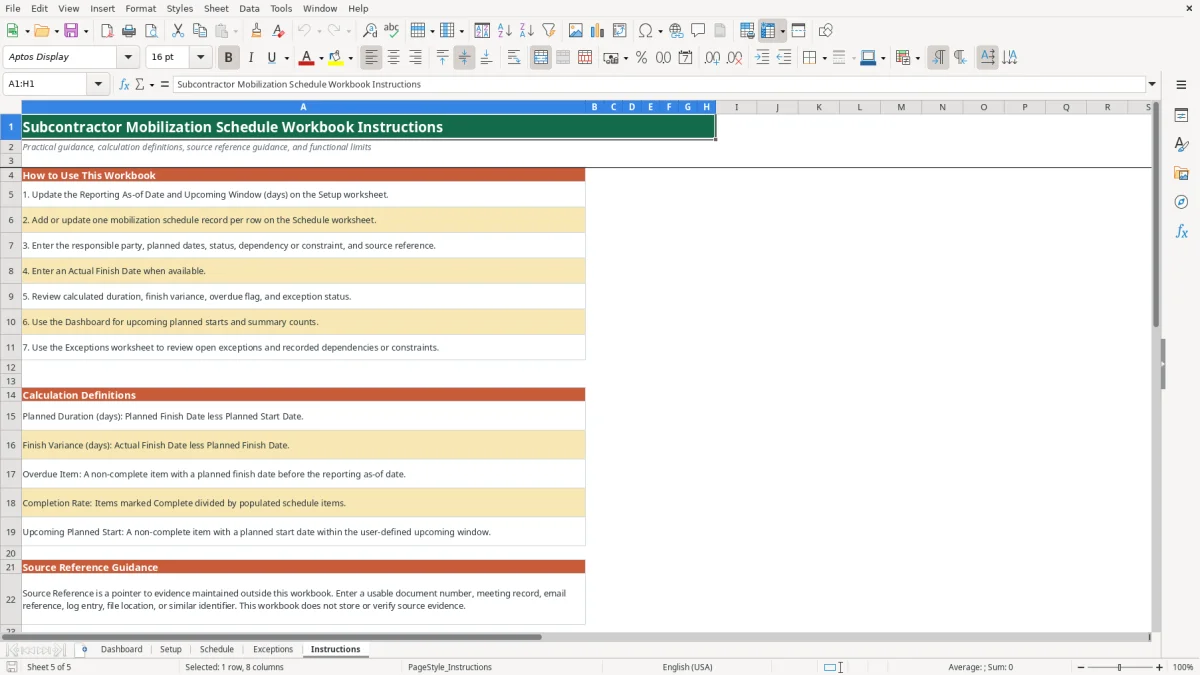
Final workbook preview
Four views generated from the verified XLSX.
How to use this workbook
Set the reporting basis
Open Setup and enter the Reporting As-of Date in m/d/Y format. Enter the Upcoming Window (days) as a whole number of 0 or more. These are user-controlled operational settings. The reporting date supports overdue calculations, and the upcoming window supports the Dashboard upcoming planned starts view.
Enter Schedule records
Maintain one mobilization schedule record per row in Schedule columns A:J. Enter the item ID, project, activity or milestone, responsible party, planned start date, planned finish date, dependency or constraint, actual finish date when available, status, and source reference. The Schedule register runs from row 6 through row 115. Use a distinct item ID for each populated record.
Use the allowed status values
Select Not Started, In Progress, Complete, Blocked, or On Hold in the Status column. Status is a user input and affects calculated review results. Enter Complete only when the user-entered record is ready to be treated as complete for workbook calculations. Update dates, status, and source references as the underlying project information changes.
Review calculated outputs
Columns K:N on Schedule are calculated outputs. They show Planned Duration (days), Finish Variance (days), Overdue Flag, and Exception Status. Do not overwrite calculated columns. Use Dashboard for summary metrics, status counts, the status chart, and upcoming planned starts. Use Exceptions to review records with an exception status and the separate dependency or constraint list.
Benefits
Maintain mobilization activities, milestones, and constraints in one controlled schedule register.
Assign a responsible party and source reference to each user-entered record.
Review calculated planned duration and finish variance in days.
Focus discussion on overdue items, open exceptions, and recorded dependencies or constraints.
Features
Five worksheets: Dashboard, Setup, Schedule, Exceptions, and Instructions.
A Schedule table covering columns A:N and rows 5 through 115.
Calculated planned duration, finish variance, overdue flag, and exception status fields.
Dynamic Exceptions views for open schedule exceptions and recorded dependencies or constraints.
Subcontractor mobilization schedule Excel workflow
This subcontractor mobilization schedule Excel workbook supports a focused workflow for maintaining scheduled activities, milestones, and constraints. The Schedule worksheet is the controlled input register. Its user-input fields are Item ID, Project, Activity or Milestone, Responsible Party, Planned Start Date, Planned Finish Date, Dependency or Constraint, Actual Finish Date, Status, and Source Reference.
The Dashboard and Exceptions worksheets are calculated review views rather than places to maintain the underlying schedule record. This separation helps users update the Schedule worksheet first, then review the resulting counts, dates, flags, and exception messages in the applicable views.
Date calculations and schedule exceptions
Planned Duration (days) is calculated as Planned Finish Date less Planned Start Date. Finish Variance (days) is calculated as Actual Finish Date less Planned Finish Date. These outputs remain blank when needed date entries are unavailable. Date calculations use the dates entered by the user and do not verify whether work occurred as recorded.
Exception Status can identify missing required record information, a planned finish date before a planned start date, a duplicate item ID, Blocked status, On Hold status, an overdue item, or an actual finish later than the planned finish. An exception is a review signal, not a determination of cause, responsibility, or entitlement.
Dashboard review for mobilization controls
The Dashboard reports the reporting as-of date and upcoming window from Setup. It calculates scheduled item count, completion rate, overdue item count, late actual finish count, and open exception count. Completion rate is calculated as records marked Complete divided by populated schedule items.
The Dashboard also displays status counts for Not Started, In Progress, Complete, Blocked, and On Hold, plus total and average planned duration in days. Its upcoming planned starts view is for non-complete items with a planned start date within the user-defined upcoming window. Confirm the Setup settings before using those results in a review meeting.
Source references and workbook limits
Source Reference is a user-entered pointer to supporting information maintained outside the workbook. A usable reference can identify a document number, meeting record, email reference, log entry, file location, or similar record. Keep the reference specific enough for the project team to locate the supporting information during review.
This workbook is an internal operational aid based on user-entered schedule records. It does not confirm field conditions, verify dates, establish contractual authority, replace source systems, replace professional judgment, or make regulatory determinations. Dashboard and Exceptions dynamic views use FILTER functions, so they require Excel 365 or a comparable Excel version that supports those functions.
Frequently asked questions
What fields are entered by the user?
Users enter Schedule columns A:J: item ID, project, activity or milestone, responsible party, planned start date, planned finish date, dependency or constraint, actual finish date, status, and source reference. Enter dates in m/d/Y format. Columns K:N are calculated from the Schedule record and Setup settings.
How is an overdue item calculated?
An item receives an Overdue Flag when it is not marked Complete, has a planned finish date, and its planned finish date is before the Reporting As-of Date entered on Setup. Update the reporting date for each new review period. The flag does not verify actual field progress.
What does the completion rate show?
Completion Rate is calculated as the number of populated schedule items marked Complete divided by the number of populated schedule items. It reflects the workbook status entries only. Review the applicable source references and current project information before treating the rate as a decision basis.
Where do I review constraints and dependencies?
Enter the dependency or constraint in the Schedule worksheet. The Exceptions worksheet contains a calculated Constraint and Dependency List that returns populated schedule records with an entry in that field. Maintain corrections or updates on Schedule, not in the calculated list.
Can this workbook replace a contract schedule or field verification?
No. The workbook controls subcontractor mobilization schedule activities, milestones, and constraints through user-entered records and calculated status views. It does not replace source systems, contractual authority, professional judgment, field verification, or project-specific review of source records.
Workbook file
Ready to put this workbook to work?
Download the verified XLSX, keep an untouched copy, and adapt a working copy to your project.
Download verified XLSXEditorial team
About the authors

Paige Sutton Vale
Workbook Systems Editor
Paige turns construction planning, cost-control, field, and closeout workflows into clear Excel workbook guides. She focuses on inputs, calculations, outputs, and practical limits.

Maren Ellsworth Keel
Workbook QA Reviewer
Maren reviews formula behavior, field labels, project-controls terminology, and workbook instructions so each resource stays within its documented scope.
Continue exploring