Verified Excel workbook
Free 2026 Construction Design Deliverables Workbook in Excel
Track planned design deliverables, owners, dates, constraints, and schedule exceptions in a free Excel workbook for internal construction review.
Keep planned design-package activities, milestones, accountable parties, and key dates in one working register. Download the free Excel workbook to record design deliverables, planned start and finish dates, dependencies or constraints, actual finishes, status, and a source reference. It is built for internal construction schedule review using user-entered records.
The workbook separates routine schedule maintenance from exception review. The Schedule sheet is the controlled input register, while the Dashboard and Exceptions sheets present calculated counts and record-level views. Source evidence remains outside the workbook; the Source Reference field identifies a document title, revision, location, or other supporting reference for the schedule item.
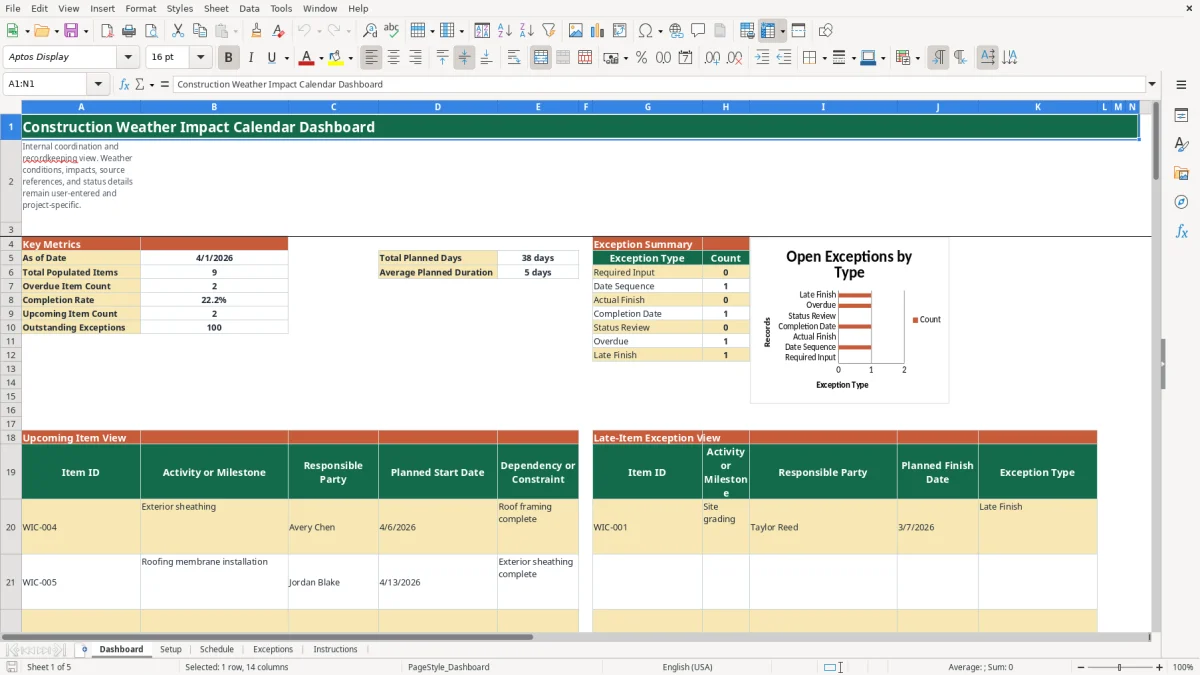
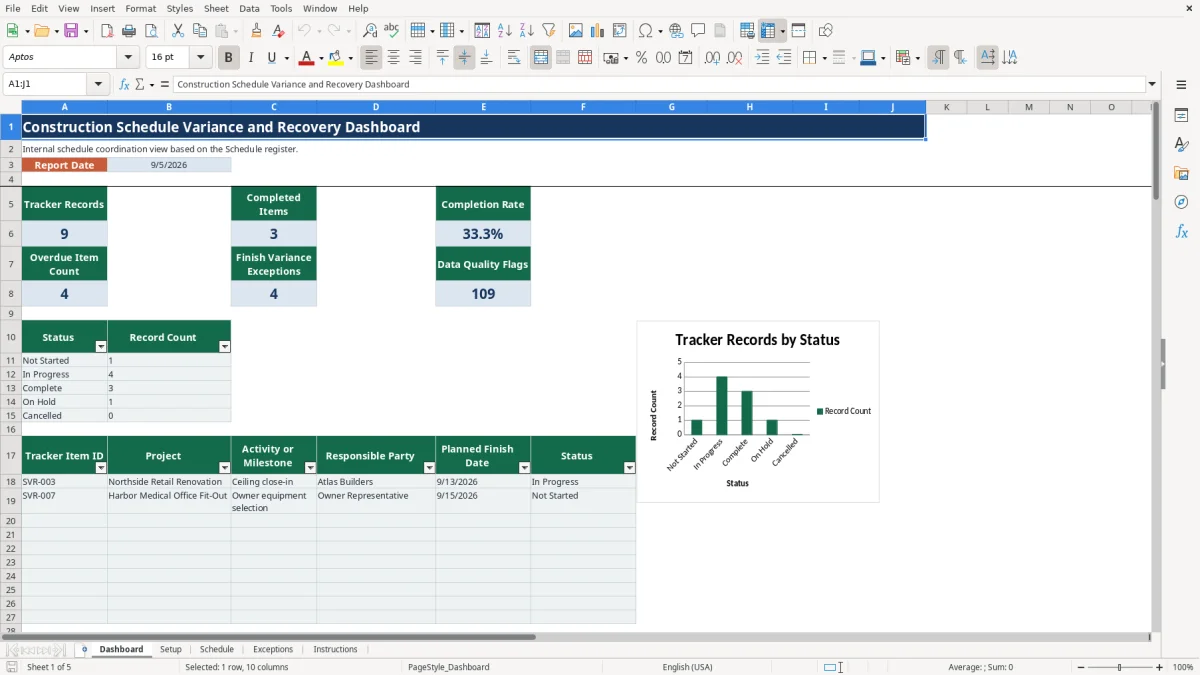
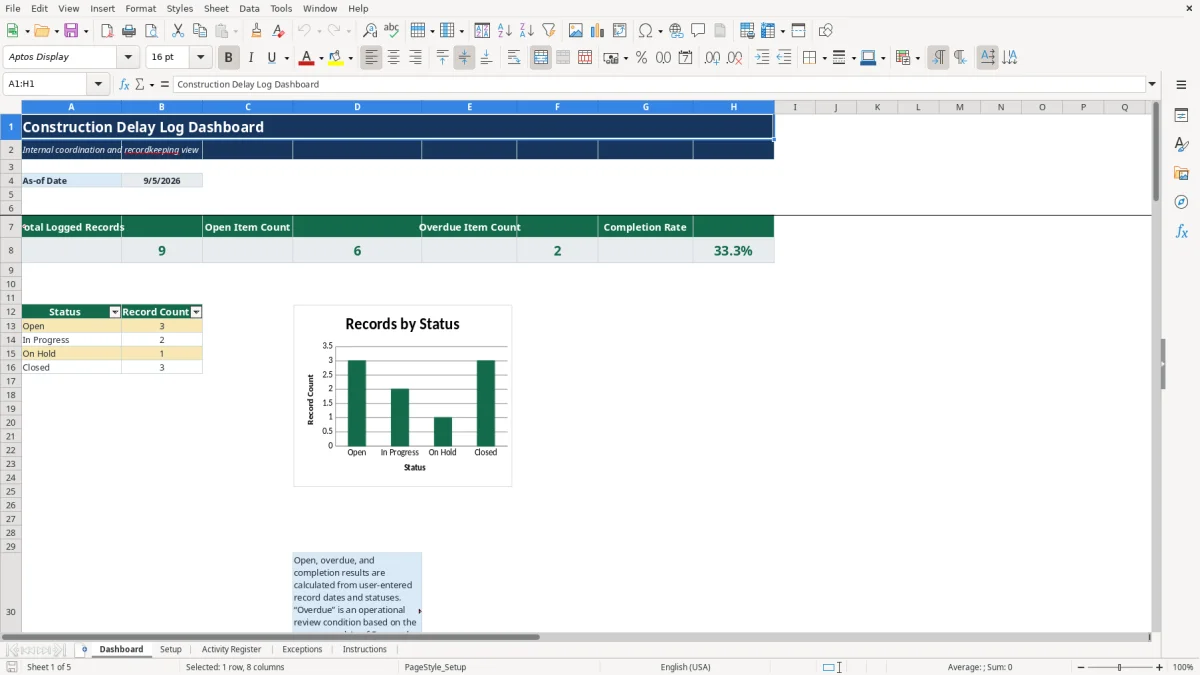
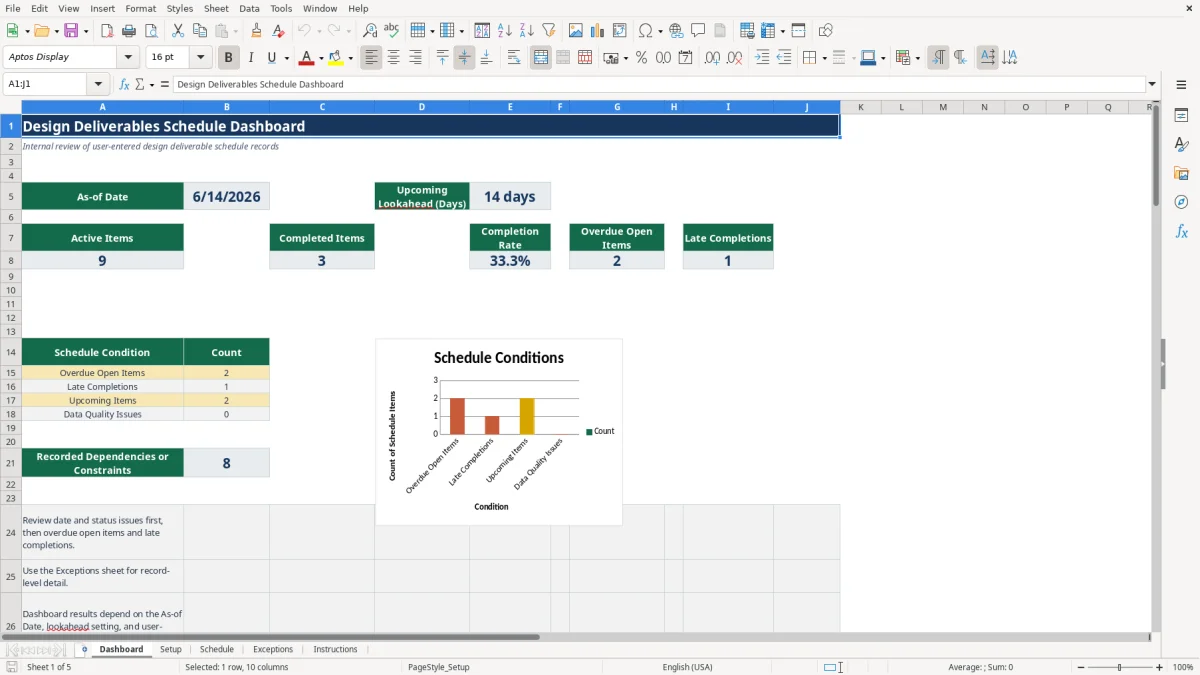
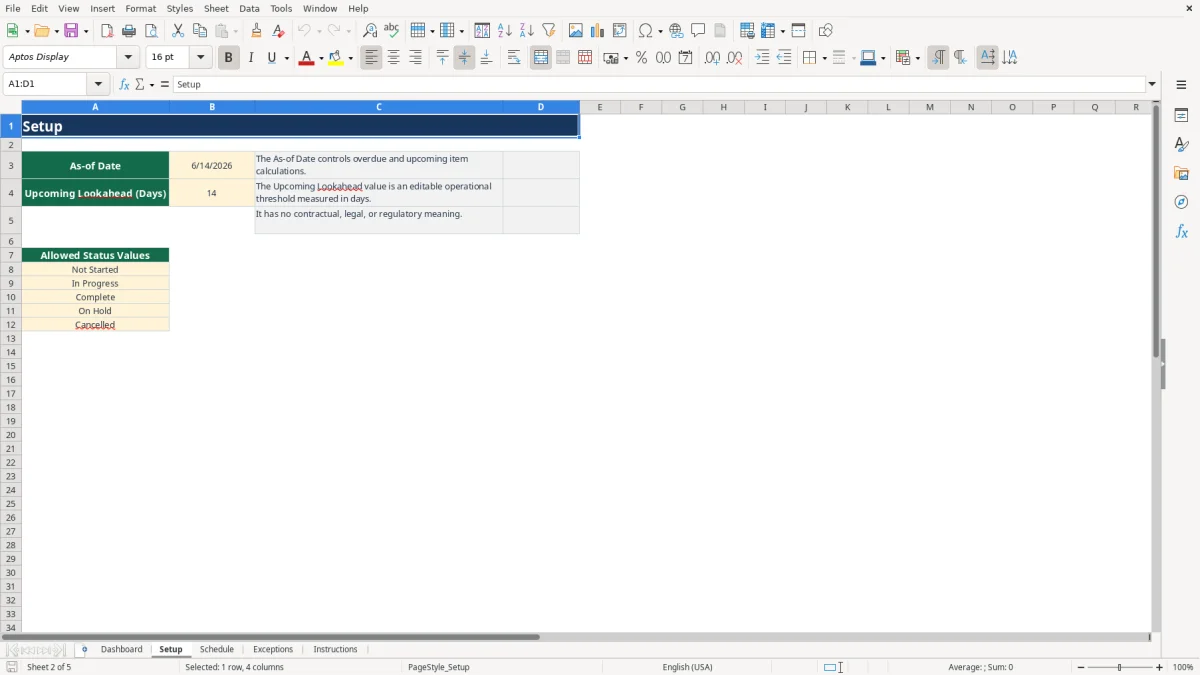
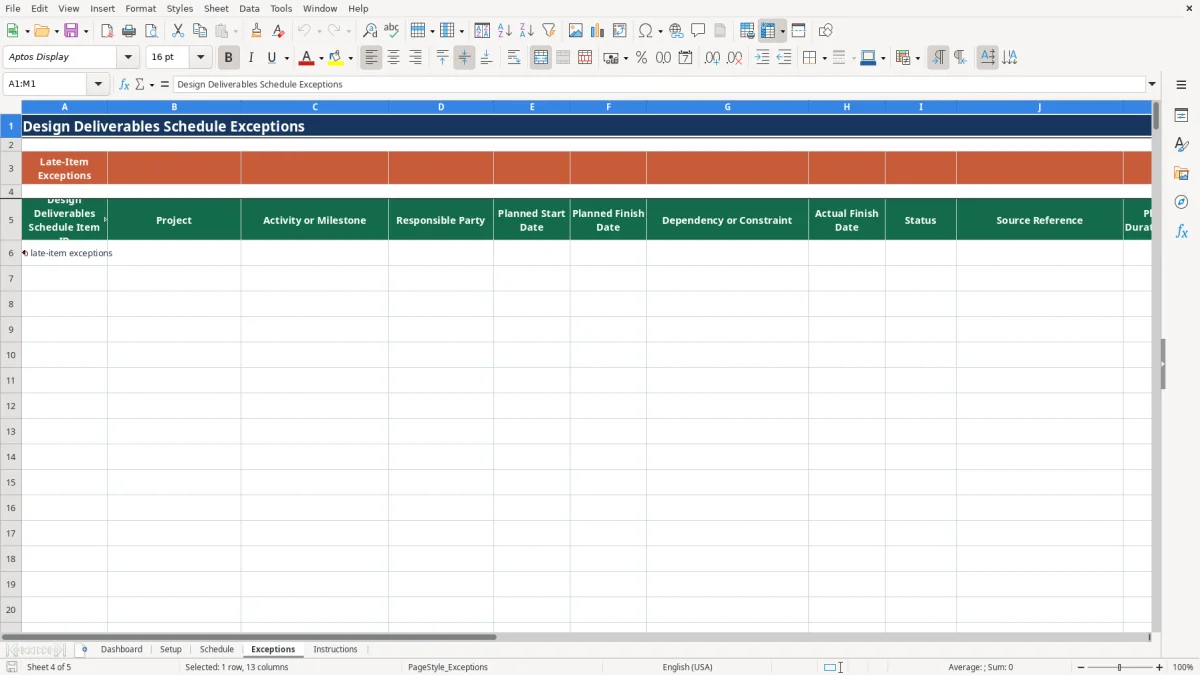
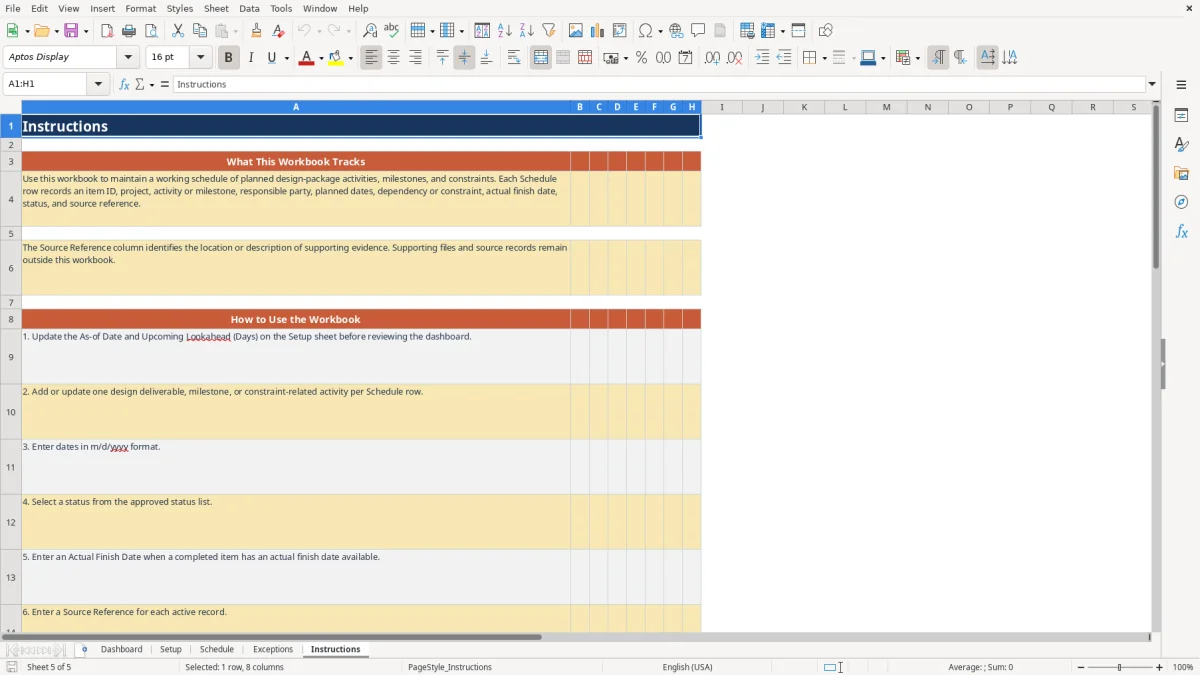
Final workbook preview
Four views generated from the verified XLSX.
How to use this workbook
Set the review date and lookahead
Start on the Setup sheet. Enter the As-of Date in m/d/Y format and set Upcoming Lookahead (Days) as a whole number of days. The As-of Date drives overdue and upcoming-item calculations. The lookahead is an internal review threshold only; it does not establish a contractual, legal, or regulatory deadline.
Maintain one schedule item per row
On the Schedule sheet, enter one planned design deliverable, milestone, or constraint-related activity per row. Provide the item ID, project, activity or milestone, responsible party, planned start date, planned finish date, dependency or constraint, actual finish date when available, status, and source reference. Use the listed statuses: Not Started, In Progress, Complete, On Hold, or Cancelled.
Leave calculated columns intact
Columns for Planned Duration (Days), Finish Variance (Days), and Schedule Condition are calculated outputs. Do not replace the calculation cells with manual values. Planned Duration equals planned finish minus planned start. Finish Variance equals actual finish minus planned finish, so a positive result means the actual finish date is later.
Review the dashboard and exceptions
Use the Dashboard to review active items, completed items, completion rate, overdue open items, late completions, recorded dependencies or constraints, and data-quality issues. Then use the Exceptions sheet for the underlying late-item, upcoming-item, constraint, and data-quality records. The Schedule table can also be reviewed by project, responsible party, status, planned finish date, or schedule condition.
Benefits
Keeps design deliverables, milestones, owners, and dates in one schedule register.
Highlights overdue open items, late completions, upcoming items, and data-quality issues.
Records dependencies or constraints beside the affected deliverable or milestone.
Uses an editable lookahead period measured in days for operational review.
Features
Five worksheets: Dashboard, Setup, Schedule, Exceptions, and Instructions.
A Schedule register with 100 prepared operational rows and calculated condition fields.
Dashboard counts for active, completed, overdue, late, upcoming, and data-quality items.
Exception views for late items, upcoming items, dependencies, constraints, and date issues.
Construction design deliverables schedule control
A construction design deliverables schedule Excel workflow is useful when a project team needs one place to maintain planned package activities and milestones without mixing that work with submittal administration. The Schedule register captures the accountable party, planned dates, status, dependency or constraint, and source reference for each item. The primary record is the design schedule item, not a review-package cycle or a technical acceptance decision.
Inputs and calculated schedule outputs
Users enter the item ID, project, activity or milestone, responsible party, planned start date, planned finish date, dependency or constraint, actual finish date, status, and source reference. The workbook calculates Planned Duration (Days), Finish Variance (Days), and Schedule Condition. A planned finish before a planned start is identified as a date sequence issue. A completed item without an actual finish date is identified for review.
These date calculations use calendar-date differences only. They do not apply a work calendar, holidays, shifts, or other project calendar rules.
Exception review for design schedule items
The Exceptions sheet provides separate formula-driven views for late-item exceptions, upcoming items, recorded constraints and dependencies, and data-quality issues. Late-item exceptions include overdue open items and late completions. An overdue open item has a planned finish date before the Setup As-of Date and is not Complete or Cancelled. Upcoming items are open items with planned finish dates from the As-of Date through the selected lookahead period.
Dashboard metrics and practical limits
The Dashboard calculates active-item count, completed-item count, completion rate, overdue open-item count, late-completion count, upcoming-item count, data-quality issue count, and recorded dependency or constraint count. Completion rate is completed active items divided by active items; cancelled records are excluded from active items. The dashboard also includes a chart based on its schedule-condition counts.
Results depend on current user entries, the As-of Date, and the lookahead setting. This internal operational aid does not verify source records, confirm completeness, establish contractual authority, or manage critical-path logic, float, resource loading, drawing distribution, submittal review cycles, or technical acceptance.
Frequently asked questions
What does this design deliverables schedule workbook track?
It tracks planned design-package activities, milestones, and constraint-related schedule items. Each record can include ownership, planned and actual dates, status, a dependency or constraint, and a source reference. It is intended for maintaining an internal working schedule of design deliverables.
How are overdue open items identified?
An item is identified as an overdue open item when its planned finish date is before the As-of Date entered on Setup and its status is not Complete or Cancelled. Review the underlying record on Exceptions and confirm the dates, status, ownership, and source reference before taking project-specific action.
What does Finish Variance (Days) mean?
Finish Variance (Days) equals Actual Finish Date minus Planned Finish Date. A positive number of days means the actual finish date is later than the planned finish date. The calculation is a date difference and does not account for working days, holidays, shifts, or schedule calendars.
Can this workbook manage submittal reviews or drawing distribution?
No. This workbook is limited to planned design deliverables and dates. It does not own submittal package-review cycles, drawing distribution, technical acceptance, or other workflows that require separate records and decisions. Supporting source files also remain outside the workbook.
Workbook file
Ready to put this workbook to work?
Download the verified XLSX, keep an untouched copy, and adapt a working copy to your project.
Download verified XLSXEditorial team
About the authors

Paige Sutton Vale
Workbook Systems Editor
Paige turns construction planning, cost-control, field, and closeout workflows into clear Excel workbook guides. She focuses on inputs, calculations, outputs, and practical limits.

Maren Ellsworth Keel
Workbook QA Reviewer
Maren reviews formula behavior, field labels, project-controls terminology, and workbook instructions so each resource stays within its documented scope.
Continue exploring