Verified Excel workbook
Free 2026 Construction Owner Decision Schedule Workbook in Excel
Free 2026 construction owner decision schedule workbook in Excel for tracking planned dates, parties, constraints, late items, and completion.
Download the free Construction Owner Decision Schedule Workbook in Excel to maintain owner-side activities, milestones, responsibilities, planned dates, constraints, and source references in one internal schedule record. It is intended for project teams that need to review owner decision items that may affect planned work.
Users maintain records on the Schedule sheet and review calculated duration, finish variance, late status, upcoming status, completion rate, and exception lists. The workbook contains Dashboard, Setup, Schedule, Exceptions, and Instructions worksheets. It is focused on owner decision schedule records, not meeting actions, field verification, contractual authority, or source-system replacement.
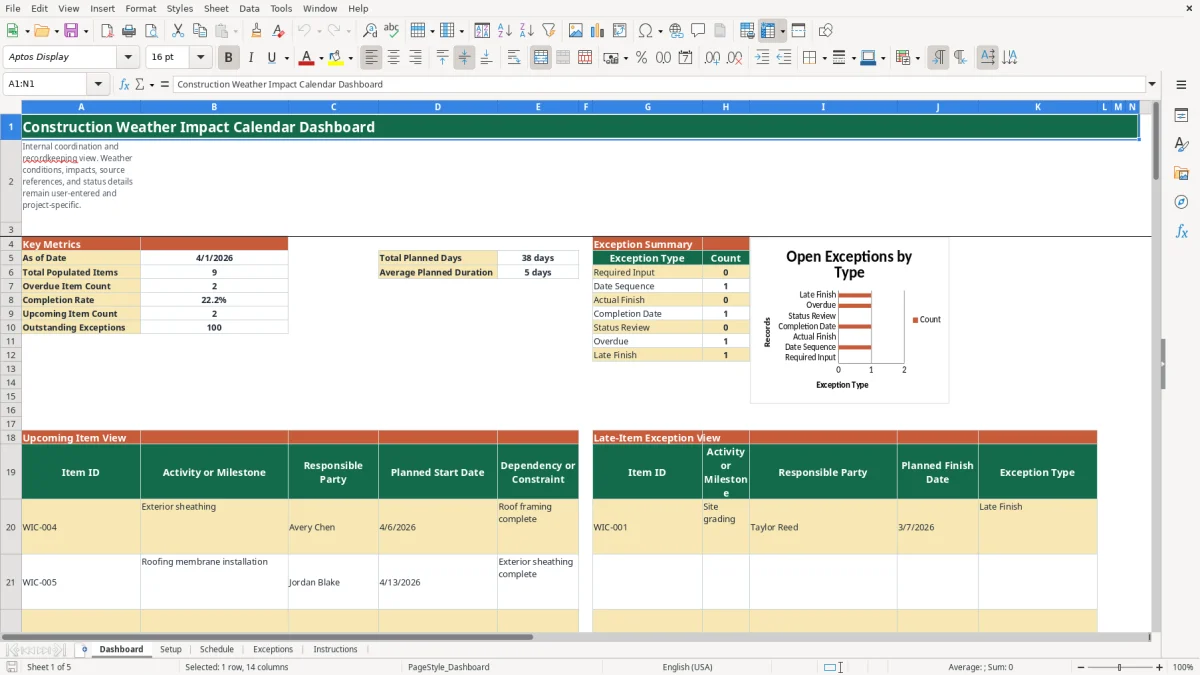
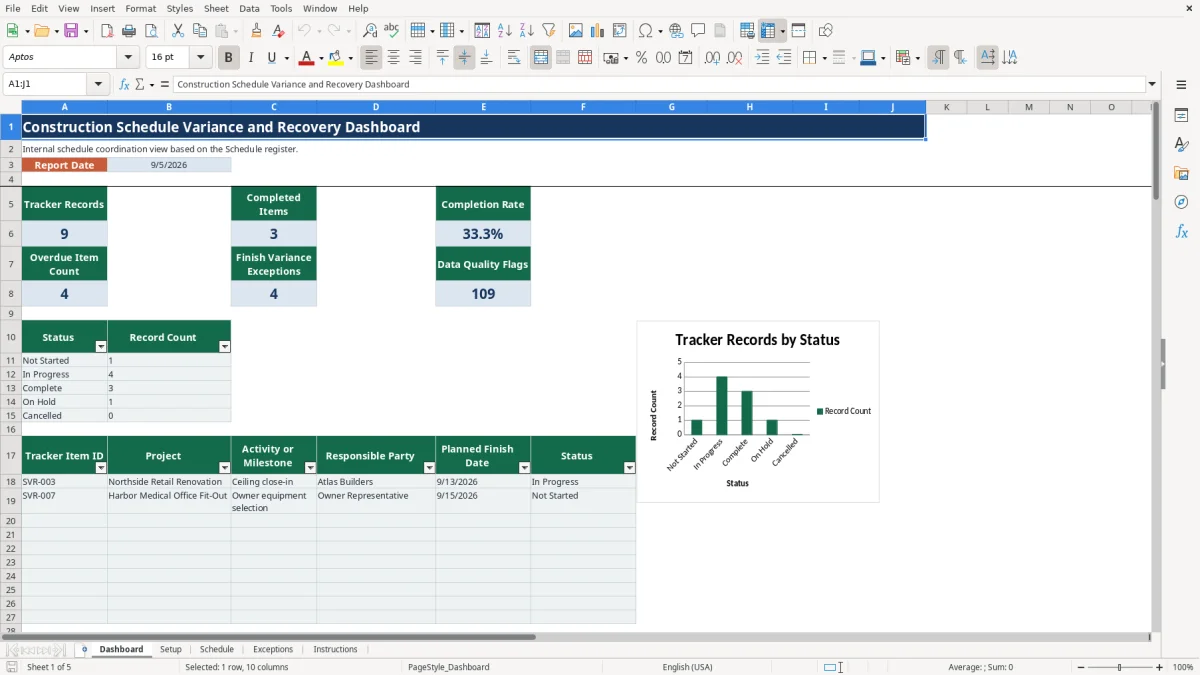
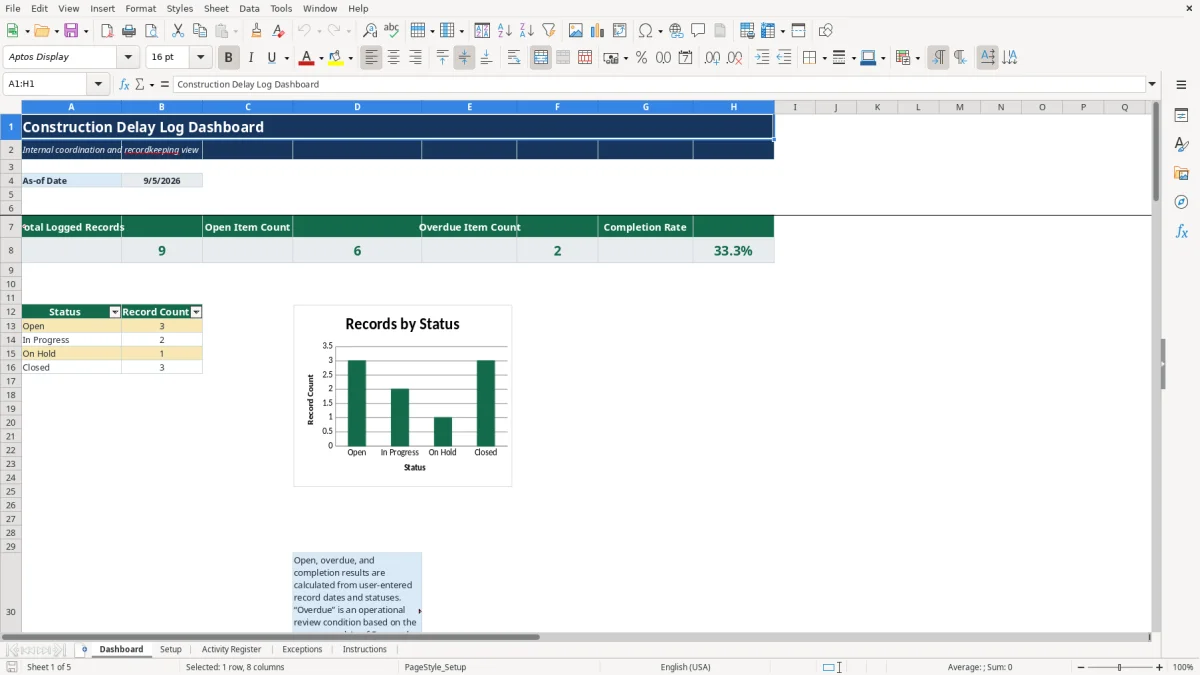
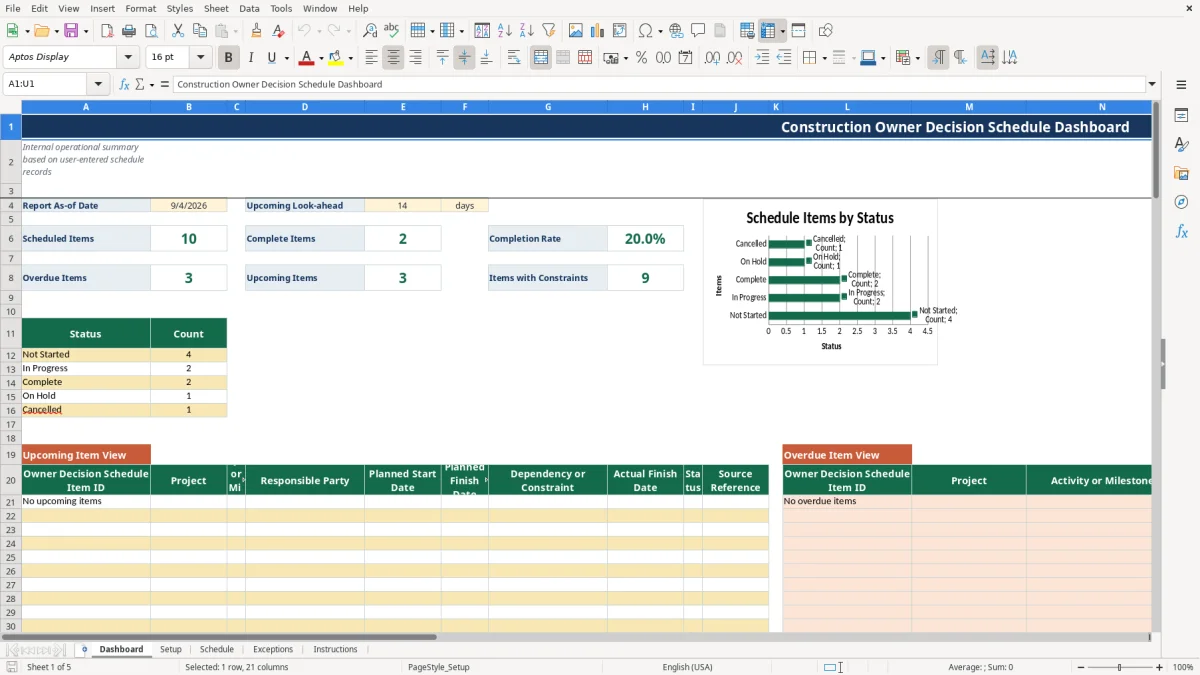
Final workbook preview
Four views generated from the verified XLSX.
How to use this workbook
Set the review controls
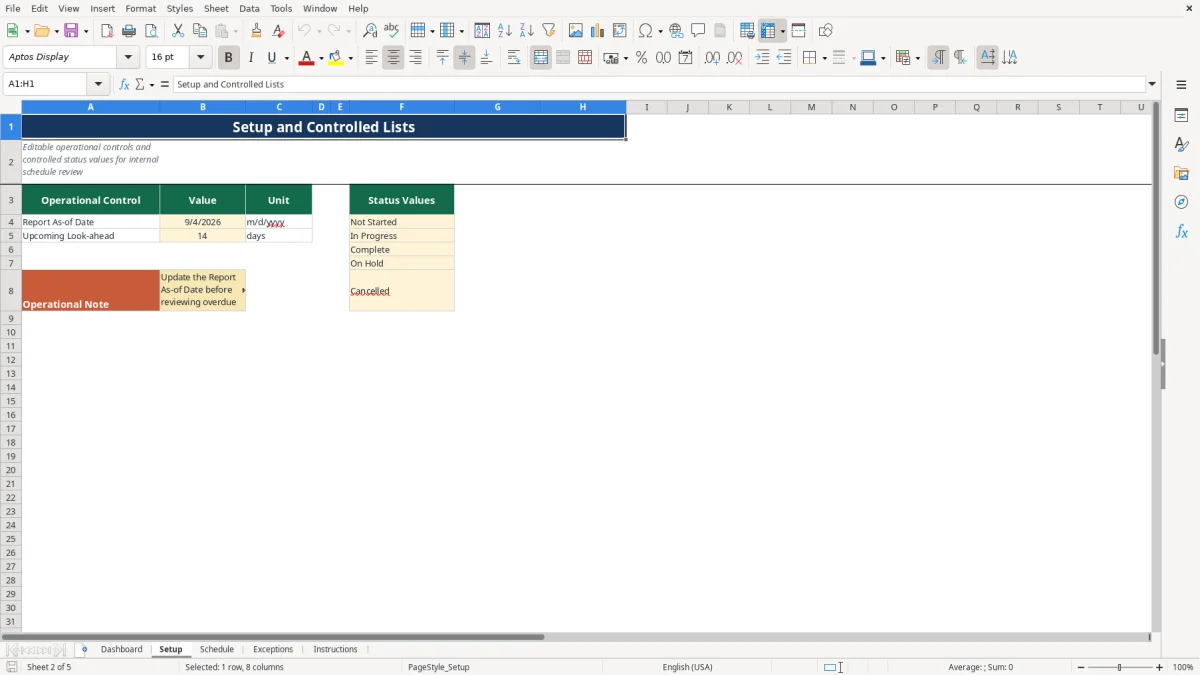
Start on Setup. Enter the Report As-of Date in m/d/Y format before reviewing current conditions. Then enter the Upcoming Look-ahead in days for the period your team wants to see in the upcoming-item view. This look-ahead is user-defined for internal operational review. Setup also lists the available status values: Not Started, In Progress, Complete, On Hold, and Cancelled.
Maintain the Schedule register
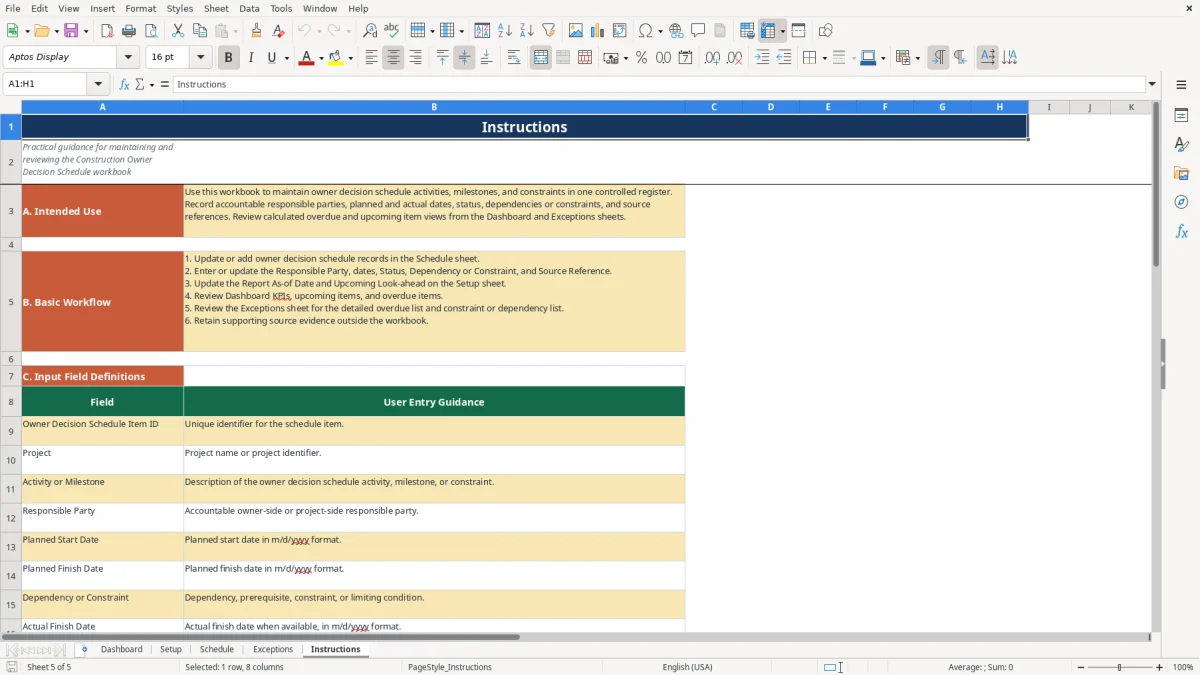
Enter or update the Owner Decision Schedule Item ID, Project, Activity or Milestone, Responsible Party, Planned Start Date, Planned Finish Date, Dependency or Constraint, Actual Finish Date, Status, and Source Reference. Use one unique item ID per scheduled activity, milestone, or constraint. Source Reference identifies supporting records maintained outside the workbook; it does not replace those records.
Check the calculated columns
Planned Duration in days is calculated as Planned Finish Date minus Planned Start Date. Finish Variance in days is calculated as Actual Finish Date minus Planned Finish Date. If an actual finish date is not entered, the finish variance remains blank. Late and upcoming flags are calculated from the planned finish date, status, Report As-of Date, and upcoming look-ahead.
Review Dashboard and Exceptions
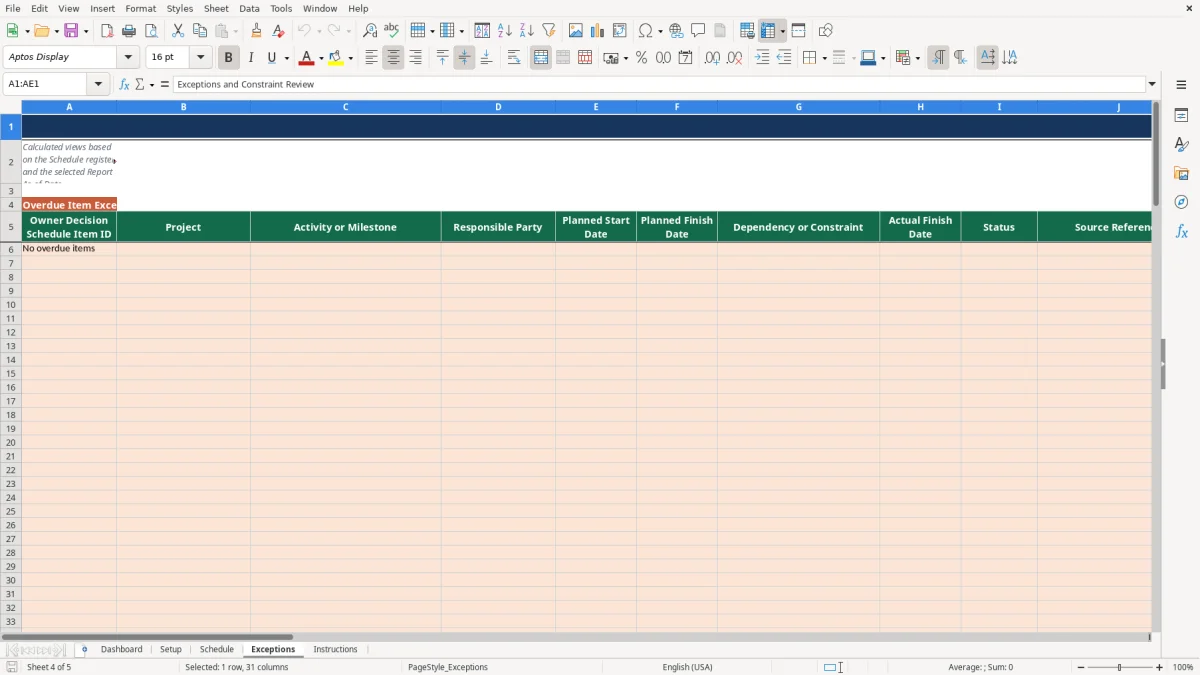
Use Dashboard to review scheduled-item counts, complete-item counts, completion rate, overdue items, upcoming items, items with constraints, and status counts. Use Exceptions to review the calculated overdue-item exception list and the constraint and dependency list. Update the Schedule register and Setup controls before using either view for an internal project discussion.
Benefits
Maintains owner decision activities, planned dates, accountability, and source references in one register.
Separates Schedule user entries from calculated duration, variance, late, and upcoming outputs.
Summarizes completion, overdue items, upcoming items, and recorded constraints for internal review.
Uses m/d/Y date entries and day-based calculations without unit conversion.
Features
Five worksheets: Dashboard, Setup, Schedule, Exceptions, and Instructions.
A Schedule register with defined user-entry fields and calculated schedule-status columns.
Dashboard counts for status, completion rate, overdue items, upcoming items, and constraints.
Calculated overdue-item and constraint/dependency lists based on Schedule records.
Construction owner decision schedule control in Excel
A construction owner decision schedule can help a project team organize owner-side activities, milestones, and constraints that need planned dates and an accountable party. This workbook provides one controlled register for those items. Each Schedule record includes the project, activity or milestone, responsible party, planned dates, status, dependency or constraint, actual finish date when available, and source reference.
The workbook is intentionally limited to owner decision schedule control. It does not replace the project schedule source system, supporting records, professional judgment, field review, or project-specific authority documents. Its purpose is to provide a decision-focused operational record and calculated status views based on the information users maintain.
Track responsibilities, dates, and constraints
The Schedule sheet is the primary place for user-entered records. Planned Start Date, Planned Finish Date, and Actual Finish Date use m/d/Y date entries. The calculated Planned Duration column returns the difference between the planned finish and planned start dates in days. The calculated Finish Variance column returns the difference between the actual finish and planned finish dates in days when both dates are entered.
The Dependency or Constraint field can record a prerequisite, limiting condition, design review, access condition, submittal package, or other project-specific dependency. The Exceptions sheet creates a calculated constraint and dependency list from Schedule records with a nonblank Dependency or Constraint entry. The workbook reports the entered condition; it does not validate the condition or its effect on the project.
Review overdue and upcoming decision items
An item receives a Late flag when its Planned Finish Date is before the selected Report As-of Date and its Status is not Complete or Cancelled. An item receives an Upcoming flag when its Planned Finish Date falls from the Report As-of Date through the user-entered upcoming look-ahead period and its Status is not Complete or Cancelled. Dashboard counts both conditions, while Exceptions lists records flagged Late.
Completion Rate is calculated as the count of Complete items divided by all nonblank schedule item IDs. Dashboard also includes status counts and a status-count chart. Calculated flags are review prompts based on user-entered records, not confirmation of field conditions, schedule causation, contractual responsibility, or source-record accuracy.
Frequently asked questions
What information do users enter in this workbook?
Users enter the item ID, project, activity or milestone, responsible party, planned start date, planned finish date, dependency or constraint, actual finish date, status, and source reference on the Schedule sheet. The date fields are set up for date entries, and the Status field uses the controlled status list shown on Setup. Planned Duration, Finish Variance, Late Flag, and Upcoming Flag are calculated outputs.
How does the workbook identify overdue items?
An item is flagged Late when its Planned Finish Date is before the Report As-of Date and its status is neither Complete nor Cancelled. The overdue-item exception list is based on that calculated Late flag. Update the Report As-of Date on Setup before review because a change to that date can change the calculated overdue-item result.
How are upcoming items calculated?
An open item is flagged Upcoming when its Planned Finish Date is on or after the Report As-of Date and on or before the Report As-of Date plus the Upcoming Look-ahead in days. Complete and Cancelled items are excluded from this calculation. The look-ahead period is entered by the user on Setup for internal operational review.
Can this workbook track USD costs or physical quantities?
No. The workbook does not include USD cost fields, budget calculations, physical quantity fields, or unit-conversion calculations. Its scope is owner decision schedule control through dates, responsibility, status, constraints, source references, and calculated internal review views.
Does the workbook replace source records or project authority documents?
No. This workbook is an internal operational aid based on user-entered records. Supporting emails, notes, schedules, logs, and other source records remain outside the workbook. Users remain responsible for project-specific review and for maintaining the records used to support their own project decisions.
Workbook file
Ready to put this workbook to work?
Download the verified XLSX, keep an untouched copy, and adapt a working copy to your project.
Download verified XLSXEditorial team
About the authors

Paige Sutton Vale
Workbook Systems Editor
Paige turns construction planning, cost-control, field, and closeout workflows into clear Excel workbook guides. She focuses on inputs, calculations, outputs, and practical limits.

Maren Ellsworth Keel
Workbook QA Reviewer
Maren reviews formula behavior, field labels, project-controls terminology, and workbook instructions so each resource stays within its documented scope.
Continue exploring